








- Delivers value and reduces waste by cutting operational costs and shifting teams from reactive fixes to proactive problem-solving.
- Unifies improvement methodologies by acting as the strategic umbrella that applies Lean and Six Sigma tools to daily work.
- Requires a structured framework combining clear governance, standard processes, and active leadership to ensure improvements stick.
Operational excellence is what enables great organizations to stay ahead of the curve, even when things get tough. This guide will show you how to build systems that grow with you, ones that are flexible, efficient, and ready for anything. Time to get started.
Definition and meaning: What is operational excellence?
What does OpEx mean?
Operational excellence (OpEx) is about consistently improving how work is done to deliver greater value faster and more efficiently, while reducing waste and inefficiency.
Here’s what that looks like in practice:
- Fewer delays and bottlenecks
- Higher-quality products or better services
- Employees solving problems, not just reacting to them
- Better use of time, energy, and resources
What is an operational excellence management system?

An operational excellence management system is a commitment to continuous improvement. You’re always asking, “How can we do this better?”
OpEx fits into your broader business strategy by helping you:
- Stay competitive
- Deliver on customer promises
- Grow without chaos
- Build a culture of ownership and accountability
What is operational excellence in manufacturing?
In manufacturing environments, operational excellence focuses on eliminating waste while maximizing productivity. Think reduced downtime, streamlined changeovers, and defect prevention rather than detection. Companies like Toyota pioneered this methodology through their Production System, demonstrating how systematic improvements create competitive advantage.
With that foundation in place, here’s why it actually matters and how it can transform your business.
Manufacturing leaders drive operational excellence with Tervene

How is operational excellence different from other models, methods, and methodologies?

When you hear about operational and organizational excellence, it’s easy to think it’s just another buzzword tossed in with Lean, Six Sigma, or continuous improvement. They’re connected, but OpEx plays a broader, often more strategic role.
Let’s walk through it, so you can clearly see where each fits, when to use them, and how they all work together.
| Approach | Main focus | Key strengths | When to use it |
| Operational excellence | Culture of improvement across the business | Aligns strategy, people, and tools long-term | – You’re ready for a big-picture transformation – You want to align strategy, leadership, culture, and execution – You’re aiming to become a truly world-class operation |
| Lean | Eliminate waste, improve flow | Fast results, easy to teach, very practical | – You’ve got clear waste (delays, overproduction, rework) – You need faster, more efficient processes – Teams are frustrated with complexity or bottlenecks |
| Six Sigma | Reduce variation and defects | Deep statistical analysis, process control | – You need precision and data-driven decisions – There are recurring product quality issues or defects – You’re aiming for high consistency and performance |
| Continuous improvement | Ongoing small changes by everyone | Builds habits, engages teams at all levels | – You want teams to own their processes – Small wins can lead to big gains over time – You’re looking to create a culture of everyday improvement |
Here’s the short version:
- Lean manufacturing focuses on eliminating waste.
- Six Sigma aims to reduce variation and defects.
- Continuous improvement is about making small, consistent changes.
- Operational excellence is about building a culture where all of those things happen – every day, everywhere.
While Lean and Six Sigma offer powerful tools and techniques, OpEx sets the foundation that makes those tools stick. It goes beyond fixing problems or tweaking processes. It’s about creating an environment where people are engaged, systems are aligned, and performance continues to rise.
Where does OpEx stand out?
All four approaches aim to improve performance, reduce waste, and deliver better outcomes. However, their approach differs.
Here’s how they connect:
- OpEx uses Lean and Six Sigma tools. They’re part of the playbook.
- Continuous improvement is a core behaviour within OpEx.
- All promote operational efficiency, quality, and better results.
Now here’s where OpEx stands out:
- It focuses on people and culture, not just advanced technology or metrics.
- It aligns strategy with execution, so teams know why they’re improving.
- It aims for long-term sustainability, not one-off fixes.
- It builds systems where improvement becomes the norm, not the exception.
In short, OpEx is about creating a business where everyone does the right things, the right way, every time.
So, what should you take away?
Think of OpEx as the umbrella. Lean, Six Sigma, and continuous improvement are the tools inside. You don’t have to choose just one, but you do need to know what you’re building.
Understanding the difference is essential, but to apply OpEx effectively, you need to know its guiding principles. These are the ideas that keep everything aligned.
Goals and benefits: Why is operational excellence important?
When you commit to doing things better every day, your business performs better, too. It’s that simple.
Here’s why operational excellence matters:
1. It boosts performance and keeps you competitive.
Markets change fast. Expectations are higher than ever.
If your team isn’t constantly improving, you’ll fall behind. OpEx helps you adapt quickly, cut waste, and stay sharp. It enables faster delivery, more informed decisions, and improved responsiveness.
2. It delivers real, measurable benefits.
When done right, you’ll see improvements across the board:
- Operational efficiency → less wasted time, effort, and money
- Product quality → fewer errors, better results
- Customer satisfaction → happier clients who stick around and refer others
- Employee engagement → people feel empowered to solve problems and make things better
Small changes build momentum. Consistent improvement leads to big wins.
3. It shapes your culture and your bottom line.
Over time, OpEx transforms how your team thinks and works. People take ownership. Silos break down. Collaboration goes up. And that leads to something powerful: a culture of continuous improvement.
That kind of culture pays off. It creates sustainable growth and long-term profitability.
With the benefits clear, you might be wondering how OpEx stands out from other improvement approaches. Here’s how it works.
Track performance and site health metrics with Tervene’s tools
Pillars: What are the core principles of operational excellence?
Operational excellence is about principles: core ideas that guide how your team works every day. These principles help you stay focused, aligned, and always moving forward.
Here’s what drives operational excellence:
| Operational excellence principles | What it looks like in practice |
| Customer focus | Small tests and pilots before significant changes |
| Respect for people | Employees are heard and involved in decisions |
| Process & system thinking | People improve the process, not just react to problems |
| Scientific thinking | Small tests and pilots before big changes |
| Continuous improvement | Daily huddles, idea boards, and quick fixes |
| Results & value creation | Teams measure success by outcomes, not effort |
Operational excellence principles set the direction. Tools help you move. Here are the key tools teams use to bring those principles to life.
What does an OpEx framework look like?

If you want to achieve operational excellence, you need a strong framework. Think of it like a blueprint: it guides how your teams work, improve, and grow together. A good framework doesn’t overcomplicate things. It brings structure, keeps everyone aligned, and makes it easier to solve problems and scale success.
Here’s a look at the key parts of a typical operational excellence methodology so you can start building (or improving) your own.
What are the core elements?
A solid OpEx framework includes a few core pieces that work together:
| Element | What it includes | Why it matters |
| Strategy alignment | Vision, goals, KPIs | Keeps everyone focused on what matters |
| Governance | Process ownership, reviews, standards | Creates consistency and accountability |
| Tools & methods | Lean, Six Sigma, visual management, SOPs | Helps teams make meaningful improvements |
| People & roles | Clear responsibilities, leadership involvement | Ensures execution and momentum |
| Feedback & learning | Daily check-ins, retrospectives, feedback loops | Builds a culture that gets better over time |
It’s not a one-size-fits-all system. You’ll need to adapt it to fit your business, culture, and customers. But the core idea stays the same: align people, processes, and purpose around continuous improvement.
How do you stay aligned?
Still, everything starts with strategy. If your OpEx work isn’t tied to clear business goals, it can easily lose focus.
Here’s how to stay aligned:
- Start with your company’s mission and long-term goals.
- Break those down into annual objectives and team-level targets.
- Make sure every improvement effort supports something meaningful.
This alignment keeps everyone rowing in the same direction. It helps you prioritize what matters most, and say no to distractions.
How do you manage and measure processes well?
You need more than just good processes. You need to manage them well. That’s where governance comes in. It’s about setting standards, making sure people follow them, and reviewing them regularly.
To keep your processes working well, start by writing them down. Make sure they reflect what people actually do. Then, assign someone to own each process so it doesn’t get forgotten.
Next, review your processes regularly. Once every few months is a good start. Talk about what’s working, what’s not, and what needs to change.
Finally, track how each process is performing. If something’s not working, adjust it. Keep things simple and focused on what helps your team every day.
Governance is about giving teams clarity and confidence. When people know how things should work, they’re quicker to spot what’s not working.
How do you build a culture of learning?
OpEx is never “done.” The best teams are constantly learning and improving.
Build feedback into your daily work:
- Ask for input from frontline teams. They see what others don’t.
- Collect data, not just opinions. Let facts guide decisions.
- Reflect often: after projects, after problems, and even when things go well.
Use tools such as daily huddles, after-action reviews, or simple surveys to keep feedback flowing. Then do something with it. Show people that their input leads to action.
Continuous learning also means developing your people. Train them in problem-solving, process thinking, and collaboration. The more capable your teams are, the stronger your culture becomes.
An excellent operational excellence framework doesn’t have to be complex. It needs to connect strategy with action, provide transparent processes to follow, and create space for feedback and learning.
To recap, here’s what to focus on:
- Tie everything back to your goals.
- Keep your processes visible, owned, and regularly reviewed.
- Make learning part of everyday work.
When you build your OpEx framework around these ideas, you’ll create a system that grows with you and gets better over time.
Got the framework? Great. Now let’s talk about how companies get started and how you can take the first steps without overcomplicating it.
Tools and examples
Operational excellence is about having the right tools to make improvements stick. These tools help you simplify processes, solve problems, and track what matters. You don’t need to use them all at once, but knowing what’s in the toolbox helps you choose the right one for the job.
Let’s break down the most common and practical tools used in OpEx.
Lean tools
Lean tools focus on eliminating waste and improving workflow. Here are a few staples:
- 5S → A simple method to organize your workspace. Sort, Set in order, Shine, Standardize, and Sustain. It makes everything cleaner, safer, and easier to manage.
- Value Stream Mapping → A visual way to map out your process from start to finish. You’ll spot delays, bottlenecks, and steps that don’t add value.
- Visual Management → Use charts, Kaizen boards, colour codes, or signs to make the status of work clear at a glance. Everyone should be able to “see the flow” without asking.
Six Sigma tools
When you’re aiming to improve quality and reduce variation, Six Sigma tools are a great place to start. They help you solve problems in a structured, reliable way, especially when those problems keep coming back.
One of the most popular tools is DMAIC. That stands for Define, Measure, Analyze, Improve, and Control. It’s a step-by-step method that helps you understand a problem, analyze the data, and test solutions that work.
You’ll define what’s broken, measure severity, analyze the root cause, improve the process, and implement controls to ensure it sticks. It’s ideal for complex or recurring issues where guesswork just won’t cut it.
Another comprehensive approach is Root Cause Analysis. Instead of addressing surface-level symptoms, this helps you get to the underlying issue. Tools such as the 5 Whys (asking “why?” five times) or a fishbone diagram help teams examine problems from different angles. You’ll uncover what’s really causing the trouble and fix it for good.
Standard work and SOPs
You can’t improve what isn’t consistent. That’s where standard work and standard operating procedures (SOPs) come in.
They clearly document the best-known way to perform a task. When everyone follows the same steps, it’s easier to spot problems, train new team members, and drive improvements.
10 Steps to implement Leader Standard Work in 4 weeks
KPIs and dashboards
You need to know if your efforts are working. That’s where key performance indicators (KPIs) and dashboards come in.
- KPIs help you track progress on what really matters, such as productivity, quality, resource allocation, safety, and customer satisfaction.
- Dashboards provide a real-time view of progress. They make it easy to spot trends, track operational goals and overall performance, and stay aligned.
Don’t overcomplicate them. Stick to a few meaningful metrics that drive decisions.
Explore 10 Visual Management Must-Haves [eBook]
Gemba walks and problem-solving frameworks
Gemba means “the real place”, where the work actually happens. A Gemba walk means going to the floor, observing the process, and talking with the people doing the work.
It helps you:
- See issues first-hand
- Understand context
- Support your team and uncover improvement ideas
Pair Gemba walks use problem-solving frameworks such as PDCA (Plan-Do-Check-Act) or A3 thinking to turn observations into action.
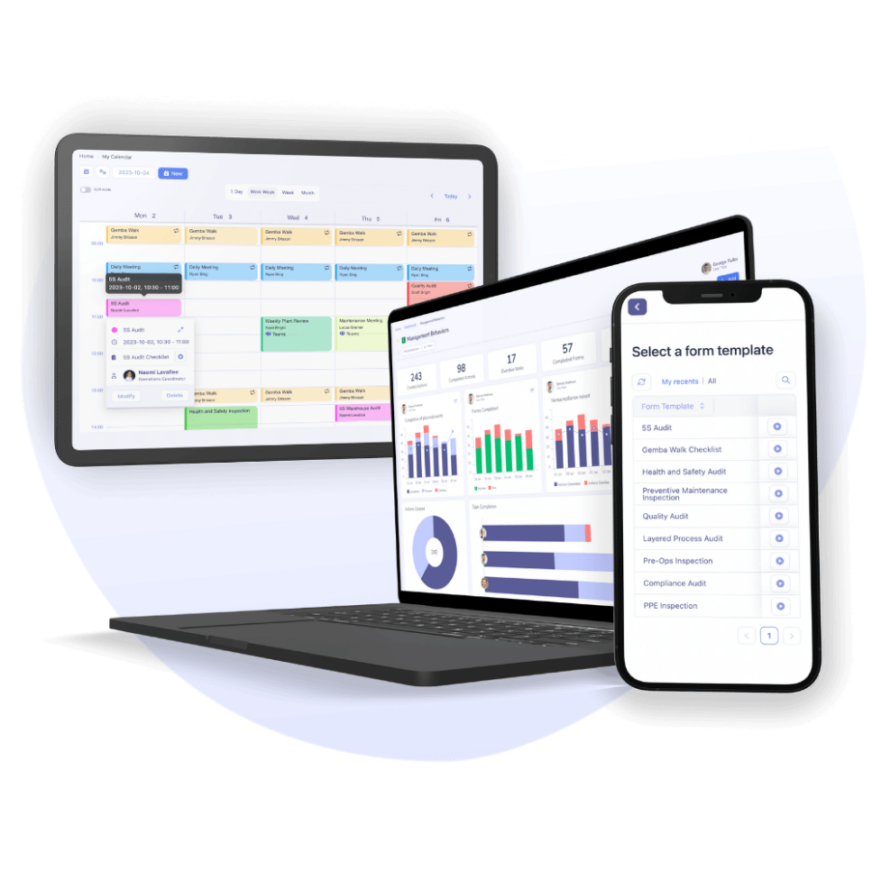
Modern tools help you take OpEx to the next level. Platforms like Tervene help teams manage daily operations, standardize routines, track issues, and improve cross-team collaboration.
Digital tools make it easier to:
- Track action plans
- Follow up on problems
- Keep communication clear and consistent through standardization
They’re invaluable for larger or multi-site organizations that need visibility and structure.
You’ve seen the most common tools. Now let’s make it easier to choose the right one for your situation. Here’s a simple cheat sheet to help you match tools to your operational goals.
| Your goal | Best tools to use | Why it works |
| Organize messy workspaces | 5S | Boosts safety and efficiency with a clean, clear setup |
| Cut down on process waste or delays | Value Stream Mapping, Lean principles | Helps you visualize and eliminate steps that don’t add value |
| Solve recurring problems | Root Cause Analysis, DMAIC | Gets to the root, not just the symptoms |
| Standardize how tasks are done | SOPs, Standard Work | Makes training easier and keeps quality consistent |
| Track daily performance | KPIs, Dashboards | Keeps teams focused and aligned on what matters |
| Coach teams and find frontline insights | Gemba Walks, Visual Management | Builds trust and reveals problems you can’t see from your desk |
| Improve something step-by-step | PDCA, A3 Problem-Solving | Encourages small, repeatable learning cycles |
You don’t need to master every tool and digital platform on day one. Start with what fits your team’s goals and build from there.
You’ve got the tools. But who actually uses them? Here are the people and roles that make OpEx happen every day.
Roles and responsibilities
Operational and organizational excellence isn’t owned by one team or leader. It’s everyone’s responsibility. When done right, it becomes part of how your entire organization works every day.
Here’s what you need to know about who plays a key role:
1. Leadership engagement (C-suite and VPs)
Good leaders support OpEx from the sidelines. Great ones lead by example. They set the vision, remove roadblocks, and keep teams focused on what matters. When leaders are actively involved, people take the work seriously. They create the space for continuous improvement and reward progress.
2. OpEx teams and change agents (directors and managers)
These are your go-to experts. They design operational excellence initiatives, train teams, and guide the process. Think of them as coaches. They help translate strategy into action. But they can’t do it alone. They need support from across the business.
3. Engaging frontline staff and middle managers
This is where the change happens. The people closest to the work often have the best ideas for improving it. Middle managers play a key role too. They turn big goals into daily actions. When you involve them early and often, change sticks.
4. Everyone’s role in sustaining improvements
OpEx only works in the long term when everyone’s on board. That means every team member takes ownership. They spot problems, suggest fixes, and keep things running smoothly. Minor daily improvements lead to significant results over time.
So, who’s responsible for operational excellence? Everyone. And when each person plays their part, you build a culture that doesn’t just fix problems. It prevents them.
It takes the whole team, but you still need a solid structure to guide the work. Here’s what a practical OpEx framework looks like in action.
Manufacturing case study: Safran Cabin Canada [VIDEO]
Safran Cabin Canada, formerly Zodiac Aerospace, uses Tervene to drive operational excellence by digitizing management practices.
Roadmap: How do you start and improve operational excellence?

Starting your journey toward operational and organizational excellence can feel overwhelming, but it doesn’t have to be. The key is to start small, stay focused, and build momentum over time.
Here’s a practical path to get moving:
1. Assess your current maturity
Before jumping into solutions, take a step back. Look at where you are today.
- What’s working?
- Where are the gaps?
Use a maturity assessment to understand your strengths and weaknesses. This provides a solid baseline to build on.
2. Set a clear vision and roadmap
Now that you know where you are, decide where you want to go.
- What does operational excellence look like for your business?
- What goals do you want to hit in 6, 12, or 24 months?
Keep your vision simple and actionable. Then map out the steps to get there.
3. Start with pilot projects
Start small. Focus on one area at a time.
Focus on:
- Processes that are visible and important
- Teams that are open to change
- Problems that impact performance
These small wins build credibility and confidence.
4. Build internal capability
OpEx isn’t a one-time project. It’s a long-term shift. Train your teams in continuous improvement. Develop problem-solving skills. Support your managers. When people feel capable, they’ll drive change in themselves.
5. Use software and digital tools like Tervene
Tools like Tervene help you structure daily operations, connect teams, and track progress. They make it easier to sustain improvements and scale what works.
As you start building momentum, it’s essential to ask: where does this all lead? To wrap up, here’s what operational excellence means over the long term.
How do you achieve operational excellence?
Excellence keeps evolving. What worked five years ago might not cut it today. New challenges show up. Customers expect more. Teams change. That’s why you can’t treat OpEx as a one-and-done project. You’ve got to keep moving, keep learning, and keep improving.
The companies that succeed don’t just follow a method. They build a mindset.
OpEx becomes part of how they think, lead, and solve problems. It’s baked into their culture. People at all levels look for ways to improve every day.
And that’s the real power of operational excellence:
- Habits make the tools work, not the other way around.
- Fixing problems is good, preventing them is better.
- Not just company leaders at the top: every person, every day, plays a role.
So, wherever you are in your journey, stay encouraged. You don’t need to be perfect. Just keep taking steps. Celebrate the small wins. Learn from the setbacks. Keep your vision in front of you.
Drive OpEx with Tervene's tools and software
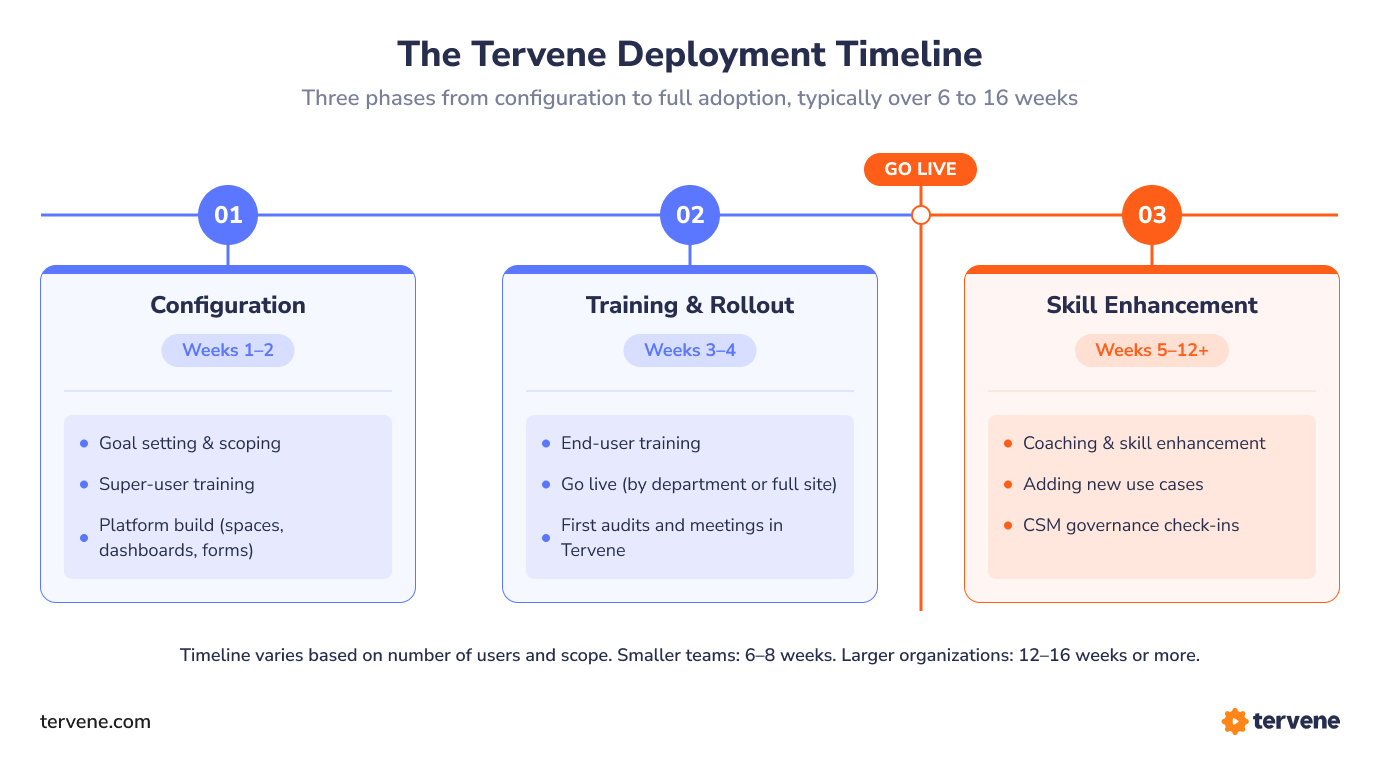
Tervene offers a complete operational excellence management system. It improves team collaboration, workplace safety, compliance, and quality management at scale.
Managers and front-line teams use Tervene to standardize daily routines, solve issues faster, make better decisions, and sustain continuous improvement at every site and level.
Successfully deploy your operational excellence program at scale
- Digitalize Leader Standard Work checklists and routines
- Track performance and site health metrics with visual management boards
- Implement a sustainable Daily Management System (DMS)
- Standardize meetings across your organization

FAQ: Operational Excellence
Operational Excellence is a business philosophy focused on consistently improving performance, reducing waste, and enhancing customer satisfaction. It involves aligning people, processes, and technology to achieve sustainable growth and efficiency.
OpEx helps businesses become more agile, resilient, and profitable by eliminating inefficiencies, improving quality, and fostering a culture of continuous improvement. It also helps organizations adapt quickly to market changes and customer demands.
Lean and Six Sigma are tools or methodologies that can be used within an Operational Excellence framework. OpEx is broader. It focuses on the mindset and cultural transformation needed to achieve long-term excellence.
The core principles include customer focus, continuous improvement, respect for people, process efficiency, data-driven decisions, and leadership commitment.
Start by identifying inefficiencies, involving your team, setting clear goals, and introducing proven methodologies like Lean, Six Sigma, or Kaizen. Pilot projects and strong leadership buy-in are essential for lasting success.
All industries can benefit, including manufacturing, healthcare, logistics, IT, and service-based companies. Anywhere processes exist, OpEx can improve outcomes.