



















Here’s what to expect during your first few weeks with Tervene.
What is Tervene?
Tervene is a Daily Management and Operational Excellence software for manufacturing and industrial organizations. It connects supervisors, managers, and executives by digitalizing, structuring, and standardizing operations across the shop floor and the boardroom.
Industrial leaders trust Tervene to set management standards across their organization


The three deployment phases
The timeline depends on the scope of your initial use, the number of people involved, and your existing processes. Regarding team sizes:
- Smaller teams are fully operational in six to eight weeks.
- Mid-sized teams with defined processes typically take 8 to 12 weeks.
- Larger multi-site rollouts may take 12 to 16 weeks or more.
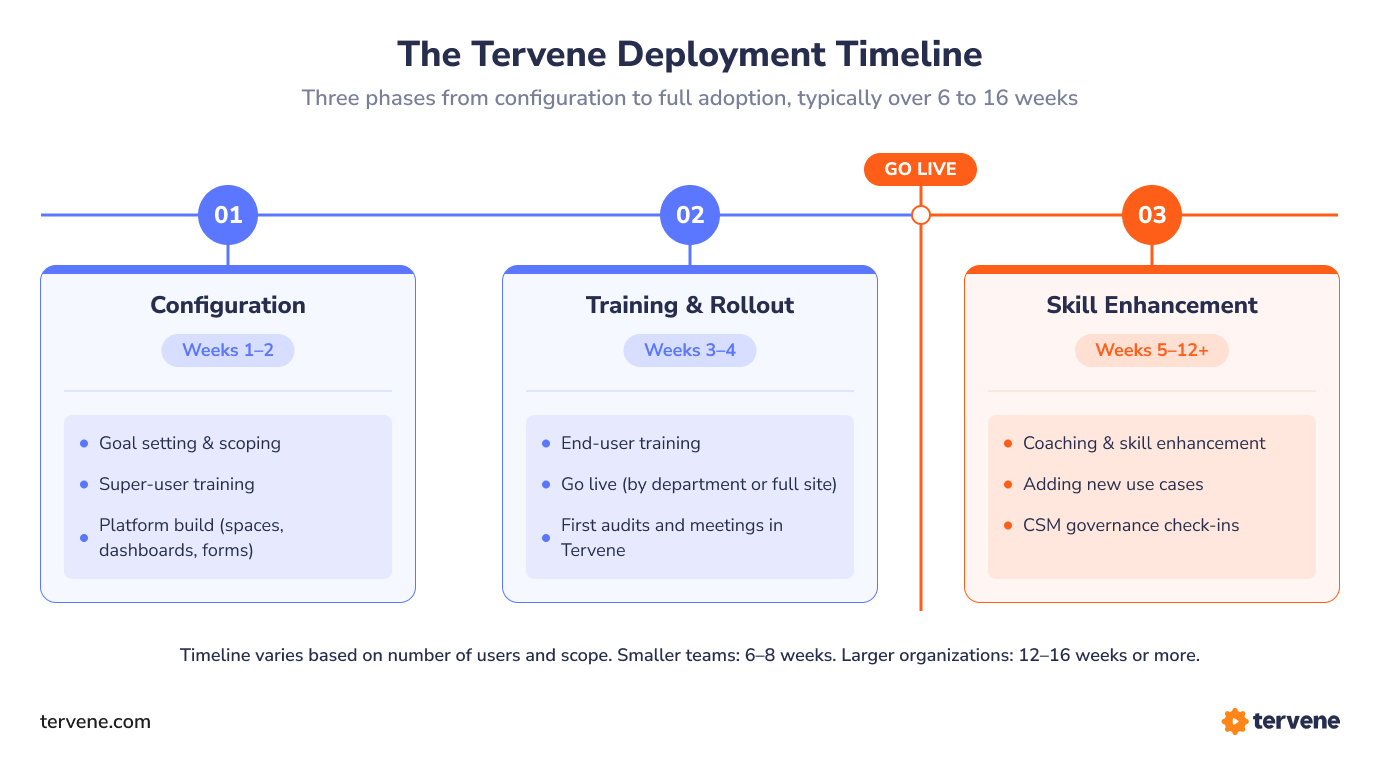
Phase 1: Setup (weeks 1 to 2)
Goal setting and scoping
The first step is for our implementation expert assigned to your project to work with your team to define what success looks like. Audit completion rates, action closure rates, meeting adherence, floor tour frequency, etc. The KPIs you set here become the baseline you measure against throughout the rollout.
Digitalizing existing practices
We then configure the software to align with your tools and processes: Gemba Walks, dashboards, audits, tiered meetings, and issue escalation flows, to name a few.
We aren’t starting from scratch. We integrate what you already do and have into our software.
Super-user involvement
Your super-users are in from the start. They learn alongside our implementation expert during the configuration process.
The software is customized to how your teams currently work. Meanwhile, they gain hands-on experience before anyone else sees it. By the time training for the rest of the organization begins in the second phase, it will already feel familiar to them.
Between sessions, they continue to add forms, action templates, and collaboration spaces. Our implementation team reviews that work and suggests improvements during the next session.
Phase 2: Training and go-live (weeks 3 to 4)
We train end users by role (team leads, managers, directors, VPs, etc.) on exactly what they need for their day-to-day. Nothing more. A supervisor running daily meetings doesn’t need to see every module. They learn their workflow, start using it, and adjust as they go.
For smaller teams, everyone launches at once. For larger organizations, it starts with a pilot (one production line, one department, or one shift). Once the pilot is up and running, we can expand.
By week 3 or 4, the first audits are conducted, and the first meetings take place inside Tervene.
Phase 3: Skill enhancement (weeks 5 to 12+)
This is when habits form, and gains become apparent.
Our implementation team remains involved through remote or on-site coaching sessions.
During this phase, processes are refined, and new use cases are added. For example, if meeting structure was the starting point, the next step might be to add operator rounds and connect them so that floor observations automatically feed into meeting agendas.
Each layer builds on the previous one.
By the end of this phase, super-users can independently reconfigure the platform, add processes, and train new team members.
Once deployment wraps up, your Customer Success Manager steps in with quarterly check-ins, software optimization, and updates on new features.
Explore Tervene’s digital tools

What determines your timeline
Two organizations can start deploying Tervene on the same day but be at different stages eight weeks later. Here are four factors that affect deployment speed:

Leadership mandate
Deployments move faster when at least one VP or Director supports them. Teams adopt the software more quickly when they know leadership is already on board.
Existing process maturity
conduct Gemba Walks, hold structured meetings, and track corrective actions are simply digit
When both the practice and the software are new, deployments can take a bit longer. That’s great; we’ve worked with clients of all kinds. It just changes the scope.
On-site vs. remote
A full day in person is more productive than a two-hour call. Remote deployments work well. Simply note that they require more scheduling discipline and tend to run slightly longer than on-site rollouts.
Internal resources
Organizations with a dedicated deployment owner or team working alongside our implementation experts move more quickly.
Discover why manufacturing leaders choose Tervene
Download your executive summary to understand how Tervene supports frontline management, continuous improvement, and daily operational control.

The must-have software for operational leaders
What you'll see in the first weeks
A clearer picture of operations
Teams can see which actions are stalling, where floor tour checklists are consistently running, and where attention is needed. Plus, items that were tracked and assigned in separate spreadsheets or follow-up emails are now in one place.
Actions getting resolved
Teams that were losing track of follow-ups start seeing things get closed out because observations move faster when they are logged and assigned to a specific person with a due date.
One process leading to the next
Most organizations start with one or two routines and expand from there. Meeting structure, then floor tours, then action templates, then corrective action tracking. Each addition lands better because the foundation is already solid.
Deploy Tervene
See what our digital tools look like for you
Our implementation team handles configuration, training, and skill enhancement, and most organizations are live within a month.
Book a tailored demo to see what deployment looks like for your team size, your industry, and your existing processes.
See how Tervene boosts operational performance by 30% in 6 to 8 weeks
- Standardize management processes
- Structure escalation processes and information flow
- Gain visibility into operations and KPIs across your sites

FAQ: Tervene deployment process
Most mid-size teams are fully operational in 8 to 12 weeks. Smaller teams with defined processes can be up and running in six to eight. Larger multi-site organizations typically take 12 to 16 weeks or more.
No. But the clearer your existing routines are, the faster configuration goes. Teams that already run structured meetings, floor tours, and corrective action tracking are bringing something that already has shape into digital format. If those practices are still being built, deployment takes more time and more coaching.
Someone close to operations. They are involved from the first configuration session and can train others, add processes, and adjust the setup.
Yes. Remote deployments work well. They require more scheduling discipline and tend to run slightly longer than on-site rollouts. A full day on the floor with a team is more productive than a series of video calls.
A Customer Success Manager takes over with quarterly check-ins, software updates, and ongoing optimization.