


















Why Tervene
Operational excellence holds when every leader runs the same routines, every day
Every year, manufacturers invest in Lean programs, leadership development, continuous improvement, and new technology. Many still face the same problems:
-
Reactive management
-
Weak follow-up on actions
-
Leaders who each manage their own way
-
Silos between departments
-
Improvement programs that lose momentum
A good strategy pays off only when every site runs it the same way, every day.
A daily discipline
Operational excellence is a discipline you reinforce every day
In most growing organizations, the gap sits between what leaders expect and what happens on each shift. Executives define how the organization should run, and frontline leaders do their best to follow. Over time, each department, shift, and site builds its own way of managing. Meetings change shape, problems get escalated through different paths, priorities shift, and routines drift apart. Nobody plans it. One day, the organization runs as dozens of separate systems.
-
Executive
vision -
Leadership interpretation
-
Different daily habits
-
Inconsistent execution
-
Unpredictable performance
Why improvement
initiatives fade
Standardized routines set how leaders work. Proactive problem-solving lets them act before a deviation grows. Operational excellence practices turn recurring issues into lasting improvements. Cross-functional alignment carries those improvements across departments. Process and performance measures show leaders what works and where the management system needs to change.
Culture is what leaders do every day, repeated until it becomes the standard.
-
Expectation
-
Routines
-
Habits
-
Culture
Where performance comes from
Leadership is the system. Operations are the output.
Many organizations work on their operational systems. Fewer work on the leadership system that runs those operations.
When leadership runs without structure, operations lose theirs soon after.
-
How problems are identified
-
How fast they're escalated
-
How teams communicate
-
How accountability is reinforced
-
How continuous improvement lasts past the kickoff meeting
High-performing organizations build systems
High-performing organizations build systems that hold when people change. Their performance comes from consistency across every site, department, supervisor, and shift. Leadership becomes repeatable, and it no longer depends on one person’s personality, experience, or memory.
Traditional Organizations
-
Leadership depends on individuals
-
Managers develop personal habits
-
Execution varies
-
Problems stay hidden
-
Performance fluctuates
High-Performing Organizations
-
Leadership follows shared standards
-
Execution becomes consistent
-
Problems surface earlier
-
Teams stay aligned
-
Performance becomes predictable

This is why we built Tervene
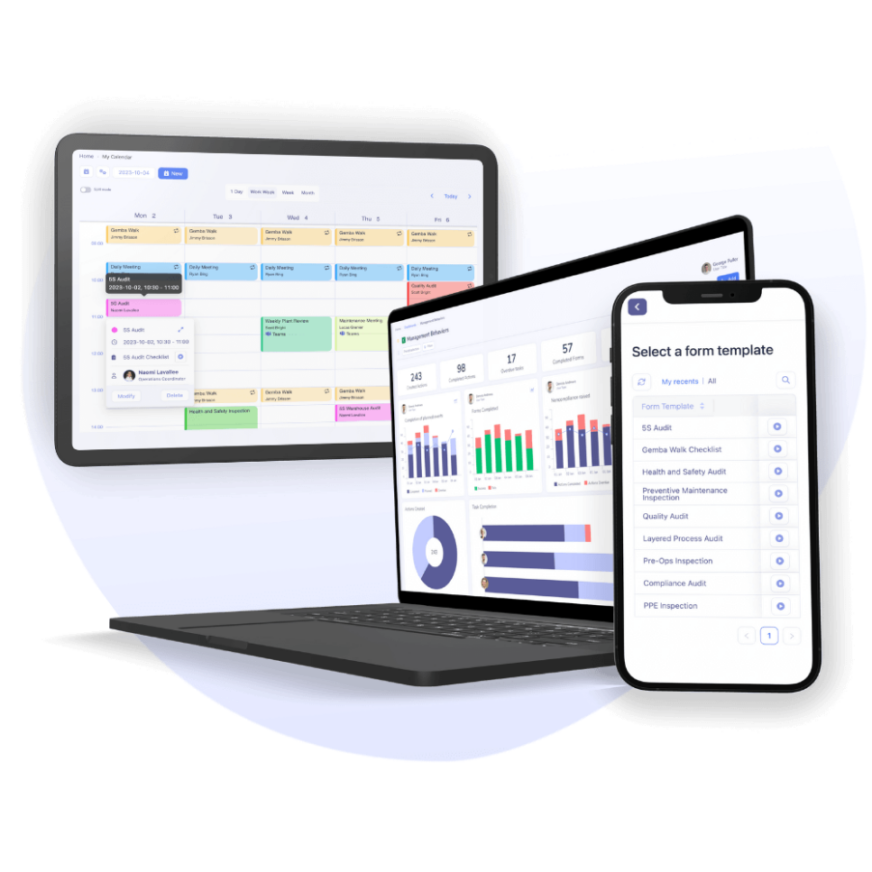
We built Tervene so leaders run the same management routines the same way, on every shift and at every site. Tervene turns a set of individual habits into one connected daily management system that:
-
Standardizes leadership routines
-
Gives every action an owner and a deadline
-
Shows problems the day they happen
-
Carries information between shifts and meeting tiers
-
Turns recurring issues into improvement actions
-
Keeps standards in place when people change
Available on iOS, Android, Windows and web.

The goal is
better operations
Better operations come from every leader applying the same management principles, every day, across the whole organization. Putting forms and meetings on a tablet is one step. Teams also need a way to make leadership execution repeatable, and Tervene gives them that.
-
Better
leadership -
Better
execution -
Better
operations
Customer testimonial
Why NOV chose Tervene
 Alexis MarchandLean and Continuous Improvement Manager, NOV
“Faced with market solutions, we chose a different approach: a tool that adapts to our Lean maturity, rather than one that imposes a predefined framework. Our priority: a customizable platform that unifies action plan management, from services to manufacturing, and helps our teams grow in problem solving. A strategic choice that combines operational performance, scalability, cost control and IT security, to make continuous improvement a real lever for lasting competitiveness.”
Next step
Operational excellence is built on every shift
See how manufacturers standardize leadership routines across shifts and sites.