
















The 5 Whys Method: Root Cause Analysis for Operations Teams
| Audience: | Continuous Improvement Manager, Production Manager, Operations Manager, Quality Manager, Team Leader, Lean/OpEx Practitioner |
| Last updated: | July 3, 2026 |
| Read time: | 8 min |



- Most teams stop too early, landing on “human error” instead of the process gap that made the error possible
- The method only works if corrective actions are assigned with a clear owner and deadline after the session
- In Lean, it runs in under ten minutes on the floor; in Six Sigma, it’s the first step before statistical analysis begins
What Is the 5 Whys Method?
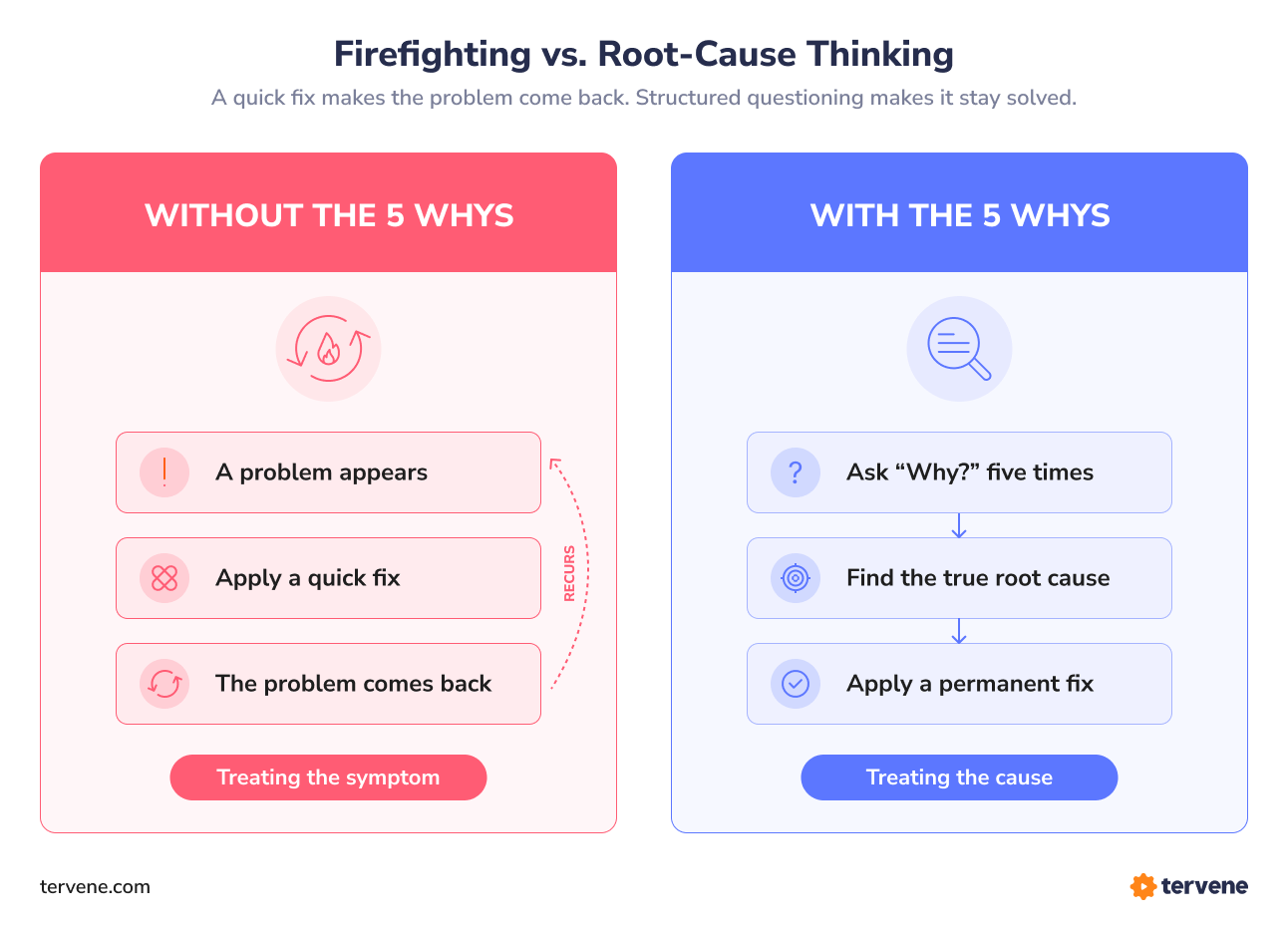
The 5 Whys is a root cause analysis technique that works by repeatedly asking “why” until the underlying cause of a problem is identified, rather than just its visible symptoms.
The most common mistake we see when a line stops or a quality issue surfaces is jumping straight to the fix. Two weeks later, the same problem is back.
That’s the gap the 5 Whys closes.
What makes it work is the fact that it forces teams to stop confusing symptoms with causes. Overheating is a symptom. A fan that hasn’t been serviced is a cause. A maintenance system that never got rolled out to that section of the line. That’s the root.

What Are the 5 Whys in the Toyota Production System?
Sakichi Toyoda built iterative questioning into Toyota’s culture. Taiichi Ohno, who shaped the Toyota Production System into a methodology, formalized it as a core diagnostic tool.
Ohno’s position was that the absence of visible problems was the biggest problem, because it meant problems were being buried rather than solved. The 5 Whys gave workers a way to surface what was actually happening, rather than applying a quick fix.
The companies that get the most out of the 5 Whys are using it as a habit, as something that runs in under ten minutes whenever an issue surfaces, right there on the floor with the people who saw it happen.
Manufacturers trust Tervene to ensure every issue is documented, analyzed, and resolved


How to Run a 5 Whys Root Cause Analysis
Step 1: Write down the problem clearly
“The machine broke” is not a problem statement. “Line 3’s conveyor stopped at 10:40 AM during the second shift, causing a 45-minute production delay.
Specificity matters here because vague problems produce vague causes.
Step 2: Get the right people in the room
Include the frontline workers who were there when it happened. The people who saw it. They have details that must appear in the report.
A common pattern we see is that when sessions are run top-down without operator input, teams tend to stop one or two levels short of the actual root.
Step 3: Ask “why” and follow the answer
Each answer becomes the next question. Don’t jump ahead, don’t assume, don’t redirect toward a solution you assume is the next logical step. Follow what the evidence says.
If you hit a dead end, that’s usually a sign the previous answer wasn’t specific enough. Back up and sharpen it.
Step 4: Don’t stop at “human error”
This is where most 5 Whys sessions fail. An operator missed a step, so the team logs “human error” and closes the ticket. That’s not a root cause; it’s a description of what happened. The real question is: why was that error possible in the first place?
What was the instruction unclear about? Was the step missing from the checklist? Was the worker running the step for the first time without adequate context? Those are the questions worth asking.
Step 5: Fix the system
Once you’ve reached a cause that’s both specific and addressable, assign it: who owns the fix, and by when. Where possible, build the correction into the process itself so the same error can’t repeat without the system catching it.
When to Use the 5 Whys (and When Not To)
When it earns its place
A problem keeps coming back. If you’ve addressed something before and it’s back, the original fix didn’t reach the root. That’s the clearest signal that a 5 Whys session is worth running. Teams that have moved from reactive firefighting to proactive management consistently identify the 5 Whys as the tool that made the shift concrete.
You’re hearing symptom-level explanations. “We ran out of time.” “Someone forgot.” “The system was slow.” Those aren’t causes. The 5 Whys pushes past them.
After an incident. Whether it’s a safety event, a production failure, or a customer complaint, the 5 Whys is a standard first step in accident investigation because it moves past “who” and gets to “what made this possible.”
When another tool fits better
The cause is already obvious and unambiguous. Not everything needs structured analysis. Save the method for problems with real diagnostic value.
You’re working with a new process and no operational history. The 5 Whys relies on evidence from what actually happened. Without data or experience to draw from, you’re guessing.
The problem is statistically complex and requires regression analysis or hypothesis testing across a large dataset. In those cases, 5 Whys is useful as a starting point (it’s used in the Analyze phase of Six Sigma’s DMAIC framework for exactly this reason), but it won’t replace deeper statistical work.
Run 5 Whys sessions directly in Tervene and track every corrective action to close


What Is an Example Using 5 Whys?
Here’s an example of how the 5 Whys method typically plays out:
A production manager at a packaging facility flagged that one of the filling machines was overheating daily, triggering unplanned stops during the afternoon shift.
- Why is the machine overheating? The cooling fan isn’t running at capacity.
- Why isn’t the fan running at capacity? It hasn’t been cleaned or serviced in six months.
- Why hasn’t it been serviced? It’s not on the maintenance schedule.
- Why isn’t it on the schedule? The team is still using paper maintenance logs for that section of the line.
- Why are paper logs still in use there? The digital maintenance system was deployed in phases, and that line wasn’t included in the rollout.
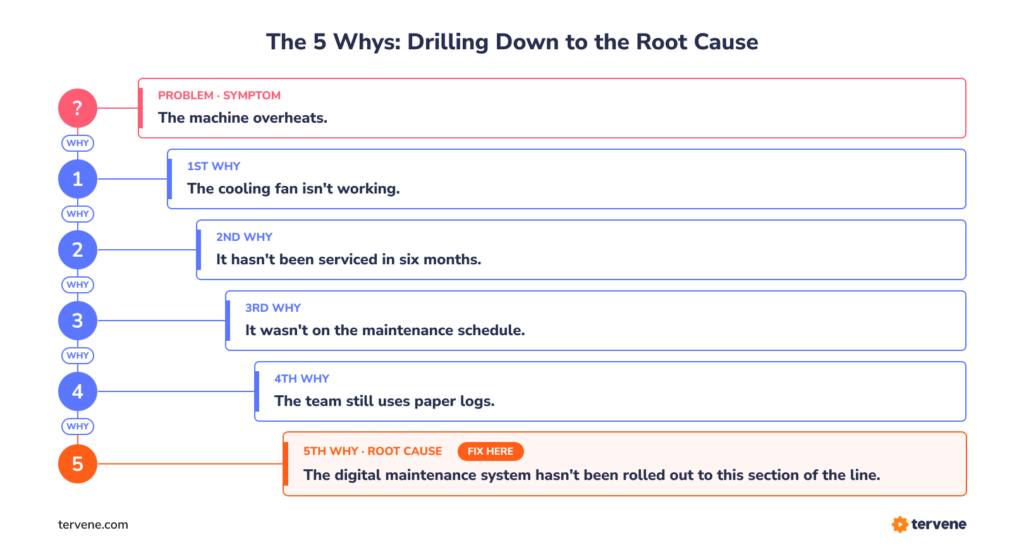
The fan was the immediate fix. But the root cause was an incomplete rollout of the digital system, which meant an entire section of the floor had no reliable way to track maintenance intervals. Once that was identified, the team completed the rollout and audited for anything else that had slipped through the cracks in the paper log.
5 Whys Template and Worksheet
The format matters less than the discipline. A whiteboard, a printed sheet, or a structured form in your lean management software all work, as long as the team actually follows the chain instead of jumping to the answer they already expected.
The structure is:
- Problem statement (specific: what, where, when)
- Why did it happen? (immediate cause)
- Why did that happen? (one level deeper)
- Why again? (keep going, don’t settle for blame)
- And why? (root cause: something addressable)
Then: who owns the fix, and by what date?
Is 5 Whys a Lean or Six Sigma tool?
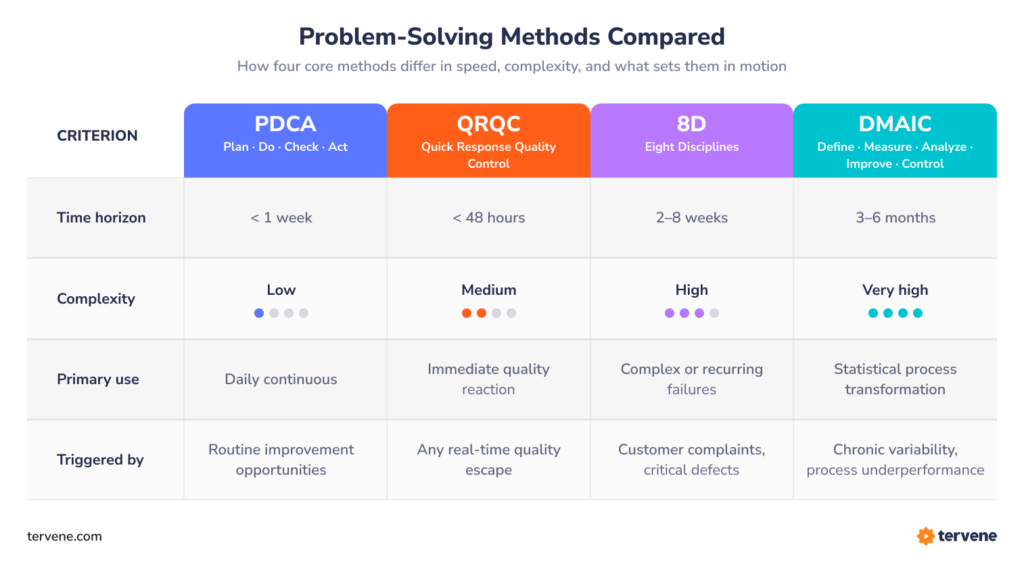
Both. In Lean, it’s a frontline tool used in daily management, team huddles, and Gemba Walks. In Six Sigma, it’s used in the Analyze phase of DMAIC before statistical work begins. The methods aren’t in conflict: Lean uses the 5 Whys at operational speed; Six Sigma uses it as a structured precursor to deeper analysis.
The two methods aren’t competing. Lean uses the 5 Whys at speed and scale across the floor. Six Sigma uses it as a precursor to deeper quantitative work. Teams working inside a PDCA cycle or QRQC framework will recognize the pattern: the 5 Whys belongs in the Plan phase, where understanding the actual cause determines whether the rest of the cycle solves the right problem.
From 5 Whys to 5 Hows
Once you have a root cause, the natural follow-on is the 5 Hows: five “how” questions that build out the corrective action from cause to implementation.
Where the 5 Whys drills down, the 5 Hows builds upward toward a fix. Used together in the same session, they take a team from symptom to solution without losing the thread between diagnosis and action.
For more complex problems that need structured documentation beyond the immediate session, teams often combine this with an A3 Problem-Solving approach, which keeps the full analysis, root cause, countermeasure, and follow-up plan in one place.
5 Whys and the Fishbone Diagram (Ishikawa)

The 5 Whys and the fishbone diagram (also called the Ishikawa or cause-and-effect diagram) work at different scales and are often used in the same session.
The fishbone gives the team a structured map of where to look. It organizes potential causes across categories: Man, Machine, Material, Method, Measurement, Environment. That breadth is useful when the problem is ambiguous and the team isn’t sure which direction to dig.
The 5 Whys then takes the most probable cause from that map and drills into it. Where the fishbone diagram provides breadth, the 5 Whys provides depth. Neither replaces the other. Start with the fishbone when the source of a problem isn’t obvious. Switch to the 5 Whys once you’ve narrowed it down to the most likely category.
Implementing 5 Whys with Tervene
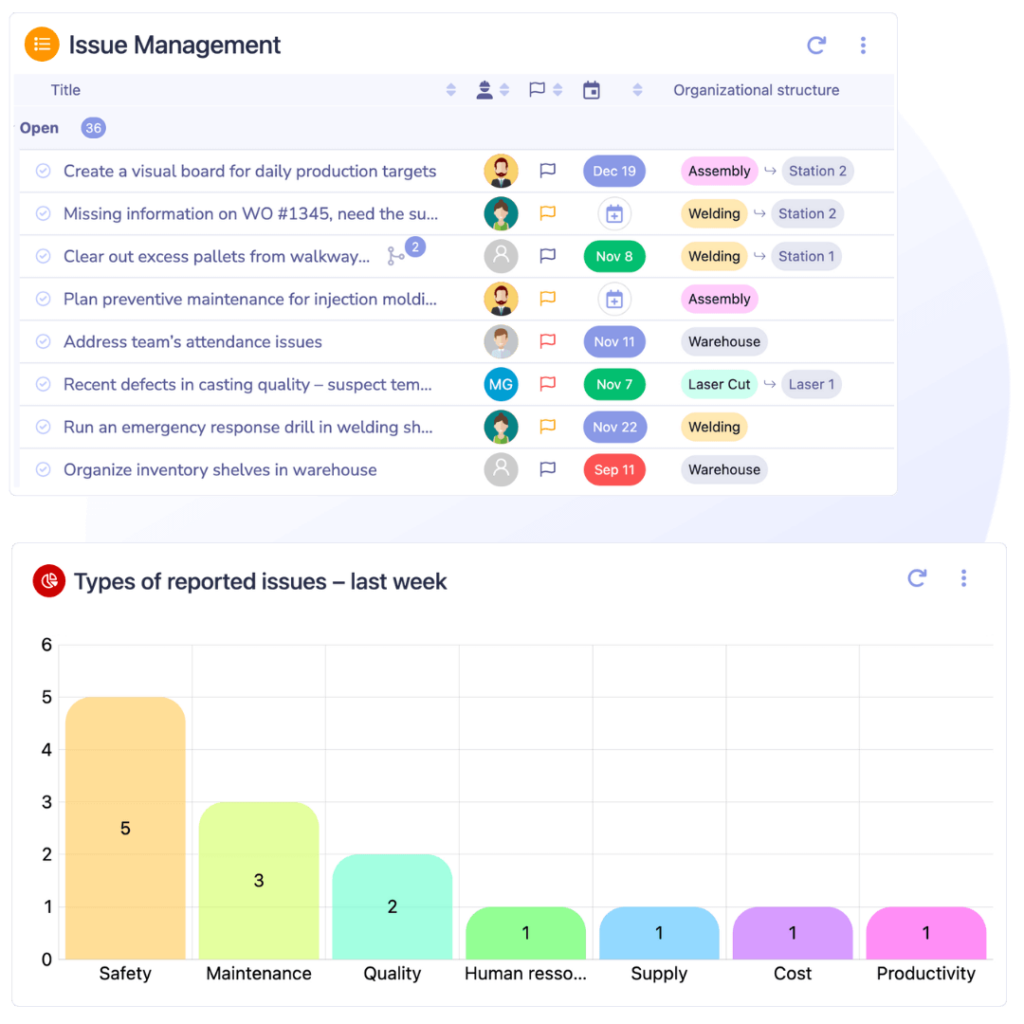
Teams using Tervene log problems at the source; the 5 Whys chain is documented within the issue; corrective actions are assigned with owners and due dates; and resolution is tracked through to closure.

Structure your problem-solving process with Tervene’s digital tools
- Log issues on the floor using pre-built 5 Why forms and structured templates
- Assign corrective and preventive actions with clear owners, due dates, and real-time tracking
- Trace every issue from detection to resolution so nothing falls through the cracks
FAQ: 5 Whys Root Cause Analysis
A root cause analysis technique: ask “why” repeatedly (usually five times) until you reach the underlying cause of a problem rather than its visible symptoms. The goal is a fix that prevents recurrence.
Why-why analysis is another name for the 5 Whys method. The term is used mainly in quality management and manufacturing, where the iterative questioning process is formalized as a structured investigation tool.
Both. In Lean, it’s a frontline tool used in daily management, team huddles, and Gemba Walks. In Six Sigma, it’s used in the Analyze phase of DMAIC before statistical work begins. The methods aren’t in conflict: Lean uses the 5 Whys at operational speed; Six Sigma uses it as a structured precursor to deeper analysis.
Write down the problem specifically. Bring in the people closest to it (including frontline workers). Ask “Why did this happen?” and use each answer as the basis for the next question. Stop when you reach a cause that’s specific and addressable. Assign the fix with a clear owner and deadline.
Yes, and it’s standard practice in workplace safety. Its value is specific: it pushes past “human error” as a final answer and surfaces the process conditions, training gaps, or environmental factors that made the incident possible.
A follow-on technique. Once the 5 Whys identifies the root cause, the 5 Hows uses five “how” questions to build out the corrective action. Together, they take a team from diagnosis to implementation in the same session.
When the cause is already obvious. When you’re working with a new process and no operational history to draw from. When the problem requires statistical analysis across a large dataset.