















How to implement Gemba walks: a 12-step rollout

| Audience: | Plant and production managers, team leaders, Lean and continuous improvement professionals, operations executives in manufacturing |
| Last updated: | November 13, 2026 |
| Read time: | 13 min |



- Before the first walk: who walks each area, who owns each kind of issue, and a checklist built for each level, with both checklists included.
- On the floor: a walk schedule that fits the shift, what to look for beyond the checklist, and why every finding waits until the walk is over.
- After the walk: a debrief within the hour, weekly action sessions, and six questions that show whether the walks still happen.
A new team leader can know every machine on the line and still have no routine for walking it. They walk when something breaks, skip the walk on a busy shift, and check different things from the team leader on the next shift. Within a few weeks, the Gemba walk becomes a tour again: no set time, no set questions, and no follow-up on what it found.
Before the first walk, most teams have the same four questions:
- Who should walk, and how often?
- What should a team leader check that a production manager doesn’t?
- What happens to an issue once it’s written down?
- How do you know the walks are still happening three months later?
The 12 steps below answer them, in the order a plant rolls them out: from getting leadership behind the walks to tracking whether they still happen six months later. The walk schedule and the Level 1 and Level 2 checklists follow the steps.
This is the implementation companion to our Gemba walk guide, which covers what a Gemba walk is and the principles behind it. Start there for the definition. Start here if you have decided to run Gemba walks and need the sequence, the checklists, and the schedule.
On the one hand, a traditional walk is a leader exploring one process or problem, with no fixed route. On the other hand, a structured walk is scheduled, follows a set checklist, and is run by team leaders and managers to catch issues before they escalate. A site can run both. The steps below are for structured walks because structure makes a walk repeatable across shifts and areas.
Before the walk: steps 1 to 6
Step 1. Secure stakeholder buy-in
Buy-in comes from showing each level what the walk does for them before announcing it as a new routine.
Executives care about where margin is leaking and why problems surface late. Team leaders care about whether the walk adds work to a shift that is already full. Operators care about whether raising a problem leads to a fix or to blame. Answer all three before the first walk. Team leaders have to find 15 minutes twice a shift, so their objection decides whether the rollout holds.
What each level gets from the walk:
- Executives: higher productivity and Overall Equipment Effectiveness (OEE), safety and compliance risks caught earlier, and team leaders who act on problems without waiting to be told.
- Team leaders: more of the shift spent on improvement and less on firefighting, and the standing that comes from leading the fixes.
- Operators: daily problems solved faster, and a regular moment to raise what gets in the way of the job.

Then name the problems the walk is meant to catch at your site, and tie them to goals leadership already tracks, such as cost, quality, or safety. The usual candidates:
- Waste: bottlenecks, rework, and process steps that add nothing.
- Communication gaps between leadership and the floor.
- Operators who feel unheard and stop raising problems.
- Problems that never show up in reports, because reports only carry what someone decided to record.
- Procedures followed differently from one shift to the next, which surfaces later as quality issues.
- Progress nobody can measure, because nothing about the floor is collected the same way twice.
If you can, bring a result from a comparable plant to the executive conversation. A number from a site like yours moves the decision faster than a description of the method.
Step 2. Map your organizational structure
Write down who walks, who receives each type of issue, and who decides when an issue moves up a level.
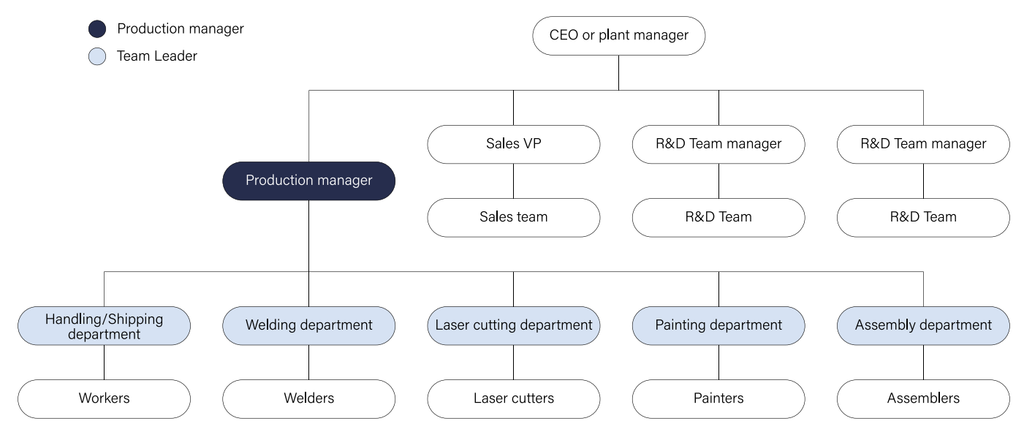
Start from an up-to-date org chart, in whatever tool you already use. Document the area and line boundaries, which walker covers which area, who records the observation, and who owns a safety issue versus a quality or maintenance issue. Then set the point at which an unresolved issue escalates to the next tier, and how long it sits before that happens. Gaps in this map show up weeks later as issues with no owner.
In the manufacturing example below, the production manager reports to the plant manager, and each department (handling and shipping, welding, laser cutting, painting, assembly) has a team leader who walks it with the operators. Sales and R&D sit outside the walk structure.
Step 3. Run the kick-off meeting
The site’s most senior leader opens the rollout in person and says why it is happening.
Keep it short. Cover what changes, what stays the same, who walks, when the first walks start, and what happens to the issues raised. State plainly that the walk is not an assessment of the operator. Resistance is the normal response to replacing a routine that already works, so name it at the kick-off, before anyone else raises it.
Step 4. Build tailored checklists by level
A checklist works when it matches both the area and the level of the person walking.
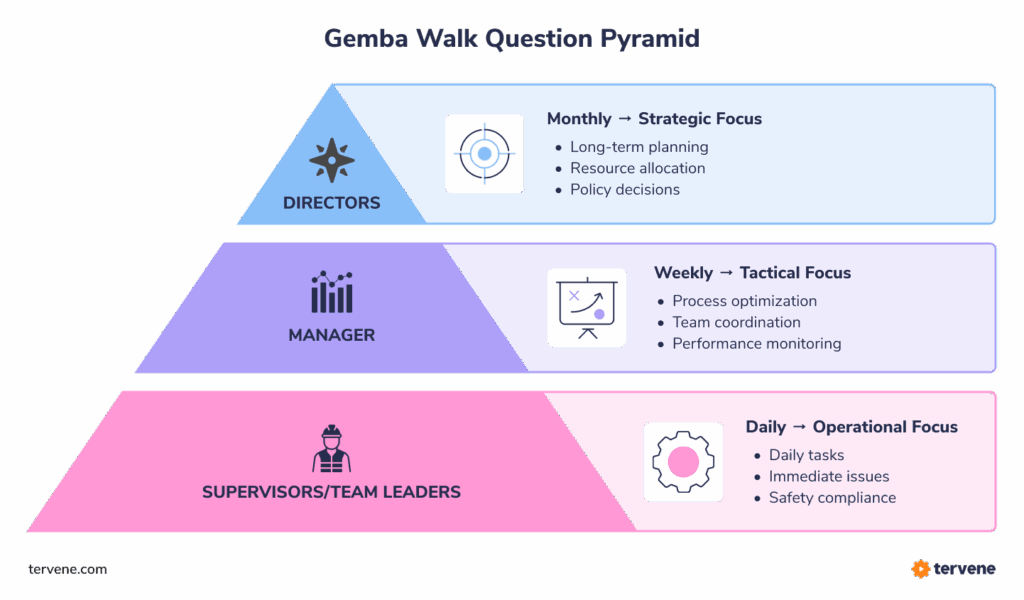
A team leader checks the condition of the area right now. A production manager checks the status of what the team leaders raised. Same area, different questions. Build each checklist with the team leader who will use it, tie every question to something the walker can act on or escalate, and align the checkpoints with the operational objectives the site already tracks. Keep the Level 1 list short enough to finish inside 15 minutes. Apply the 80/20 principle: the handful of checks that catch most of what goes wrong. The Level 1 and Level 2 checklists further down this page are a starting set. For more example questions by role, see our Gemba walk checklist guide.
Step 5. Set the walk schedule
Fix the frequency for each level and put it in the calendar, because a walk with no scheduled time is the first thing dropped on a bad shift.
Team leaders walk 2 to 4 times per shift, at least every 2 hours. Production managers walk once for every 2 team leader walks, scheduled after the second one so they arrive with both sets of findings. Publish the schedule so operators know when the walk is coming. A predictable rhythm lets operators plan around it and lets managers catch problems while they are still small. A sample day is in the schedule template below. For example, on a day shift, team leaders walk at 8:00, 10:00, 13:30, and 15:30, and the production manager walks right after the 10:00 and 15:30 walks.
Add an occasional group walk during working hours with people from different roles, so everyone sees the same process the same way. Listen to how each process is explained on these walks: when the person running it cannot explain it simply, the process usually needs work.

Step 6. Train for the walk
Train people on the questions they ask on the floor.
Shadowing works better than a classroom session. Walk with each team leader on their first few walks and coach three things: asking open questions that surface a cause instead of a yes-or-no answer, writing an observation specific enough that someone who wasn’t there can act on it, and keeping to time. Compare “Why is this machine down again?” with “What happened with this machine, and what would stop it happening on the next run?” The first invites a defense. The second produces a corrective action.
While you shadow, watch four things:
- Does the operator understand what the team leader is doing and why?
- How does the team leader engage with the operator?
- How well does the team leader understand the operation in front of them?
- Are they using open and follow-up questions, or only yes-or-no ones?
During the walk: step 7
Step 7. Walk proactively
Follow the checklist, then look at everything it does not cover.
The checklist catches the problems you already know about. The value of the walk is catching the ones it doesn’t cover yet. Watch for work piling up between two stations, an operator reaching or bending more than the task should require, materials staged where they block a path, and instructions at a station that no longer match the job running. Ask one follow-up question before moving on.
Here is how that works on a painting station. The checklist asks whether the painter has every work order detail for the current job. The follow-up questions dig further:
- What is the color code for this job?
- What quality standard applies to it?
- How many units are in this batch, and does the schedule avoid unnecessary changeovers?
- How do you paint these pieces, and why do you do it this way?
- What would you change to improve the painting process?
Record each finding against its checklist point and work area, with a photo where the issue is physical. Resolve nothing during the walk. Note it, finish the walk, then act. Seeing every area before acting is what lets you rank the problems, and stopping to fix the first one turns a 15-minute walk into an hour while the rest of the floor goes unseen. Budget about 1 minute per work area.
After the walk: steps 8 to 12
Step 8. Run the post-walk debrief
Sort the findings by risk and impact before assigning anything.
Hold the debrief within the hour, while the detail is still fresh. Rank each finding on two axes: risk to safety and impact on output or quality. Anything carrying a safety risk gets an owner the same day. For example, a missing guard on a press gets an owner before the end of the shift, while a label printer that jams twice a day can wait for the weekly action session. Give every remaining issue an owner and a due date. An issue with neither comes back unchanged on the next walk.

Step 9. Hold weekly action sessions
Once a week, review every open action with the team leaders who own them.
Cover three things: what closed, what is blocked and why, and what is new. Many teams hold this session at the area’s Gemba board, where the open actions are already on display. Issues that need more than a quick fix get a method attached. A housekeeping problem that keeps returning gets 5S. Repeated stock-outs between stations get Kanban. A recurring machine fault gets a maintenance request or an equipment change. Keep the session to the actions. New problems go on the walk list.
When an issue keeps coming back after it was fixed, find its root cause before choosing the next fix: run the 5 Whys or an Ishikawa (fishbone) diagram. A fix aimed at the cause is the one that stops the issue from returning to the walk list.
Step 10. Set a continuous improvement target
Give each team leader a weekly target for improvement opportunities raised. Two per week is a reasonable starting point.
A target keeps the walk focused on finding improvements as well as catching faults. For example, a team leader on a packaging line might raise one opportunity about changeover time and one about where cartons are staged. Adjust the number once you see what your floor actually produces. Track opportunities separately from issues, because they behave differently: an issue has to be closed, an opportunity has to be chosen.

Step 11. Track adherence
Measure whether the walks are happening as scheduled before you measure what they found.
Review six questions, per walker and per area:
- Are the walks happening at the scheduled frequency?
- Are issues being logged, or handled verbally and lost?
- Are the walks finishing inside their allotted time?
- Is every area in scope actually being covered?
- Do the issues raised line up with the objectives the checklist was built around?
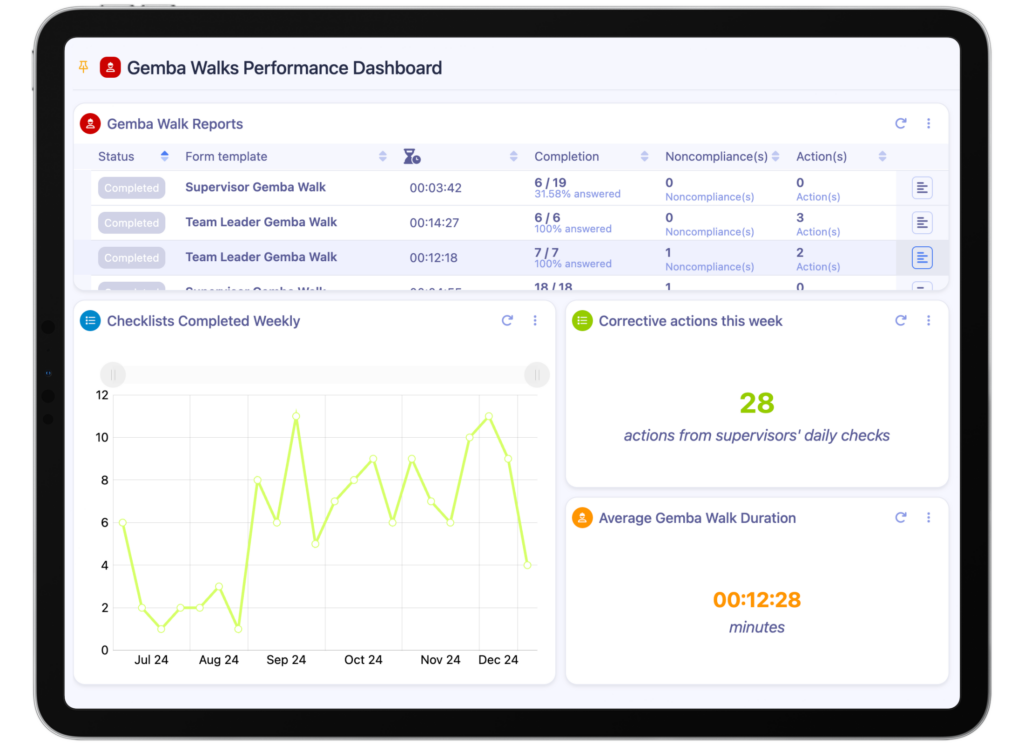
- Are the actions getting closed, and how long do they take?
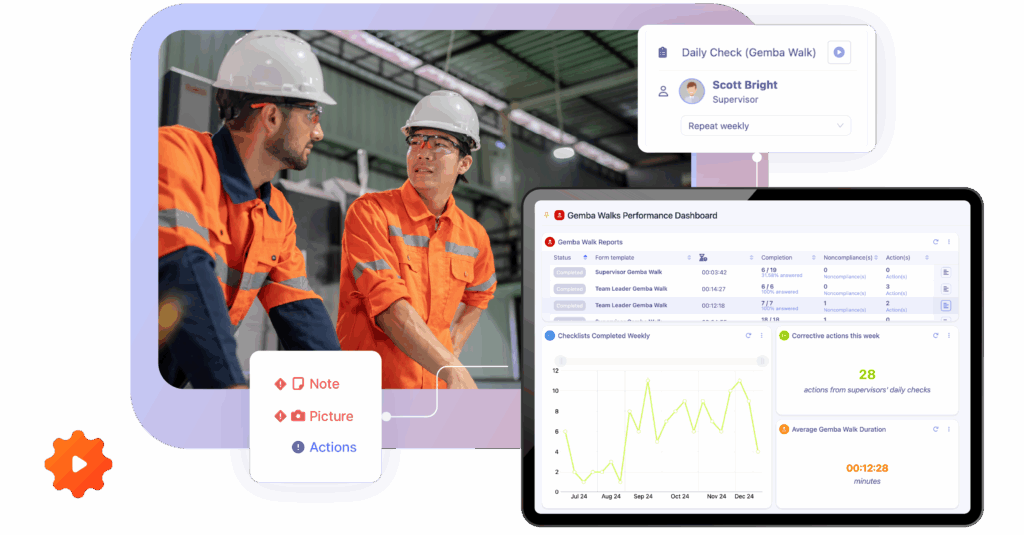
Then categorize the findings by department, process, or problem type so you can see which categories keep coming back and which areas produce the most. Read the categories by walker too. If one walker reports almost every issue in the same category, look at the walker and the area: it can point to a blind spot or a training need. The spread of findings across departments also shows which areas and management approaches are working, which tells you where to aim the next improvement effort. Falling adherence is the first sign a rollout is slipping, and it shows up before the issue count moves.
Step 12. Choose software that holds the routine
At some point the schedule, the checklists and the follow-up stop fitting on paper.
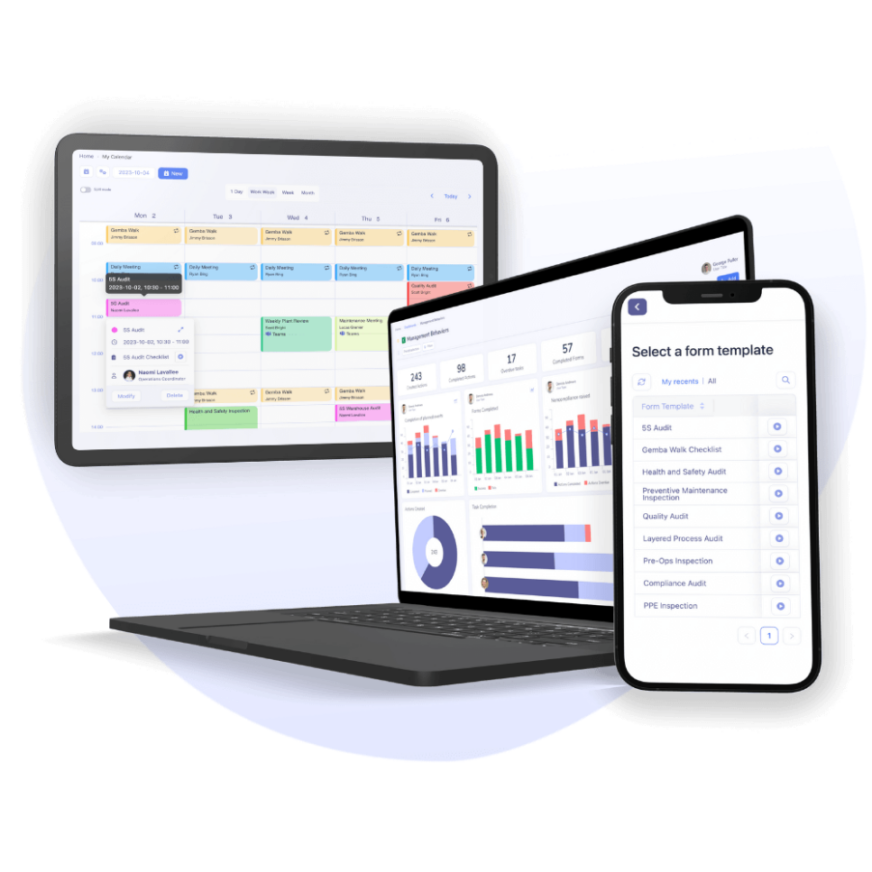
Look for a calendar with reminders tied to each walker’s schedule, checklists linked to the area and the level so the walker always opens the current version, issue capture that holds the photo, the owner, and the due date in one record, escalation from one tier to the next without re-keying, and adherence data you can read per walker and per area without building a report. Judge each option on one question: does your existing routine fit it?
The walk schedule and checklists
A typical walk schedule
Team leaders walk at Level 1, frequently. Production managers walk at Level 2, less often; each Level 2 walk is right after the second Level 1 walk so the manager receives what both team leader walks found. A day with four Level 1 walks and two Level 2 walks looks like this:
| Time | Level 1 (team leader): frequent walks | Level 2 (production manager): less frequent walks |
|---|---|---|
| 08:00 | Gemba walk 1 | |
| 10:00 | Gemba walk 2 | |
| 10:15 | Gemba walk with team leaders 1 (after walks 1 and 2) | |
| 13:30 | Gemba walk 3 | |
| 15:30 | Gemba walk 4 | |
| 15:45 | Gemba walk with team leaders 2 (after walks 3 and 4) |
Level 1 checklist for team leaders
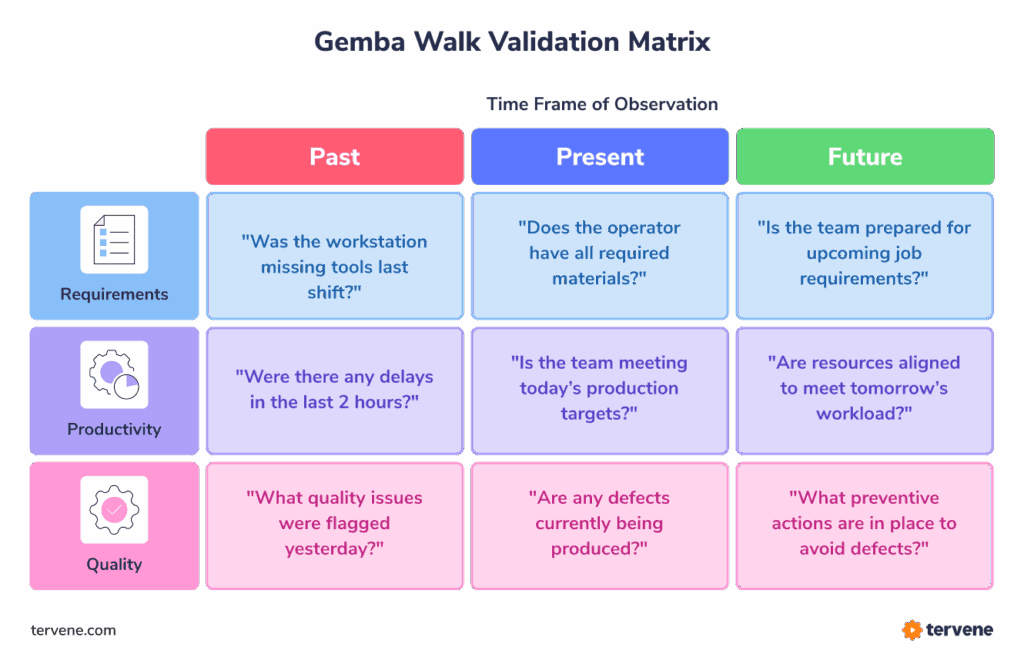
The Level 1 checklist looks for two kinds of problems: issues that already happened (so recurring ones get new questions and get ironed out) and issues that are about to happen (so they can be prevented). Every question takes a yes-or-no answer. Keep the Level 1 walk under 15 minutes and run it at least every 2 hours. Every extra question costs walk time, and past a certain length, team leaders skim, and problems slip through.
| Time | Category | Subcategory | Question |
|---|---|---|---|
| Past | Requirements | Information | Were there any unforeseen issues with the required tools, materials, personnel, or information in the past two hours? |
| Past | Quality | Information | Have there been any unexpected quality problems in the past two hours? |
| Past | Productivity | Information | Have there been any unforeseen dips in productivity in the past two hours? |
| Present | Requirements | Worker | Is the worker currently at their designated workstation? |
| Present | Requirements | Worker | Is the worker clocked in for the correct job assignment? |
| Present | Requirements | Information | Does the work order provide all essential details and specifications for the job? |
| Present | Requirements | Information | Does the worker understand the procedures and standards for the current job? |
| Present | Requirements | Information | Does the worker have the proper training for the current job? |
| Present | Requirements | Equipment | Does the worker have all the necessary tools for the current job? |
| Present | Requirements | Equipment | Are the tools in perfect working order? |
| Present | Requirements | Equipment | Does the equipment need maintenance? |
| Present | Requirements | Material | Does the worker need any material for the current job? |
| Present | Quality | Information | Is the worker aware of the quality standards for the current job? |
| Present | Quality | Information | Are quality standards being followed consistently? |
| Present | Quality | Material | Is the worker aware of the quality rate goal? Is it achievable? |
| Present | Productivity | Information | Are health and safety standards being followed? |
| Present | Productivity | Information | Is the production rate on schedule? |
| Future | Requirements | Information | Is the worker aware of the priority and the work order details for the next job? |
| Future | Requirements | Information | Does the worker have all the required materials for the next job? |
| Future | Requirements | Information | Does the worker understand the procedures and standards for the next job? |
| Future | Requirements | Information | Does the worker have the proper training for the next job? |
| Future | Requirements | Equipment | Does the worker have all the necessary tools for the next job? |
| Future | Requirements | Material | Will the parts be ready and available on time for the next job? |
Level 2 checklist for production managers
Some issues need more authority or resources than a team leader has. The Level 2 walk is where the production manager works through those with the team leaders and checks that the Level 1 routine is holding. Every question takes a yes-or-no answer.
| Time | Category | Subcategory | Question |
|---|---|---|---|
| Past | Requirements | Information | Did team leaders report any unforeseen problems related to tools, materials, personnel, or information during their Gemba walks? |
| Past | Quality | Information | Have any unexpected quality issues been flagged in the past two hours? |
| Past | Productivity | Information | Have any dips in productivity occurred, and do they require investigation? |
| Past | Productivity | Information | Can we identify any significant areas of waste within the department that could be reduced? |
| Past | Productivity | Information | Are there any outstanding issues identified by team leaders that need immediate attention? |
| Present | Requirements | Worker | Did all team leaders complete their scheduled Gemba walks? |
| Present | Requirements | Information | Are team leaders aware of the current priorities? |
| Present | Requirements | Equipment | Is immediate equipment maintenance needed? |
| Present | Requirements | Material | Does the department have all the necessary materials for the current job? |
| Present | Quality | Information | Are quality standards being consistently met? |
| Present | Quality | Material | Is the quality rate goal known and met by all team members? |
| Present | Productivity | Information | Are health and safety standards being strictly adhered to? |
| Present | Productivity | Information | Is the production rate on track? |
| Present | Productivity | Information | Is the takt time being consistently met? |
| Future | Requirements | Information | Does the work area require additional personnel to handle the next job effectively? |
| Future | Requirements | Information | Are there any other outstanding issues that need to be addressed? |
Take the checklists with you
The same 12 steps, Level 1 and Level 2 checklists, and walk schedule are in the Gemba walk implementation ebook as a PDF you can print for the floor.

Gemba walks: 12 steps, checklists and templates
Standardize your Gemba walks with Tervene
Mars Wrigley completed 6,500-plus Gemba walks with Tervene. 97% of the issues raised during those walks were resolved or turned into actions. Across 1,100-plus audits and inspections, 95% of the resulting tasks were closed.
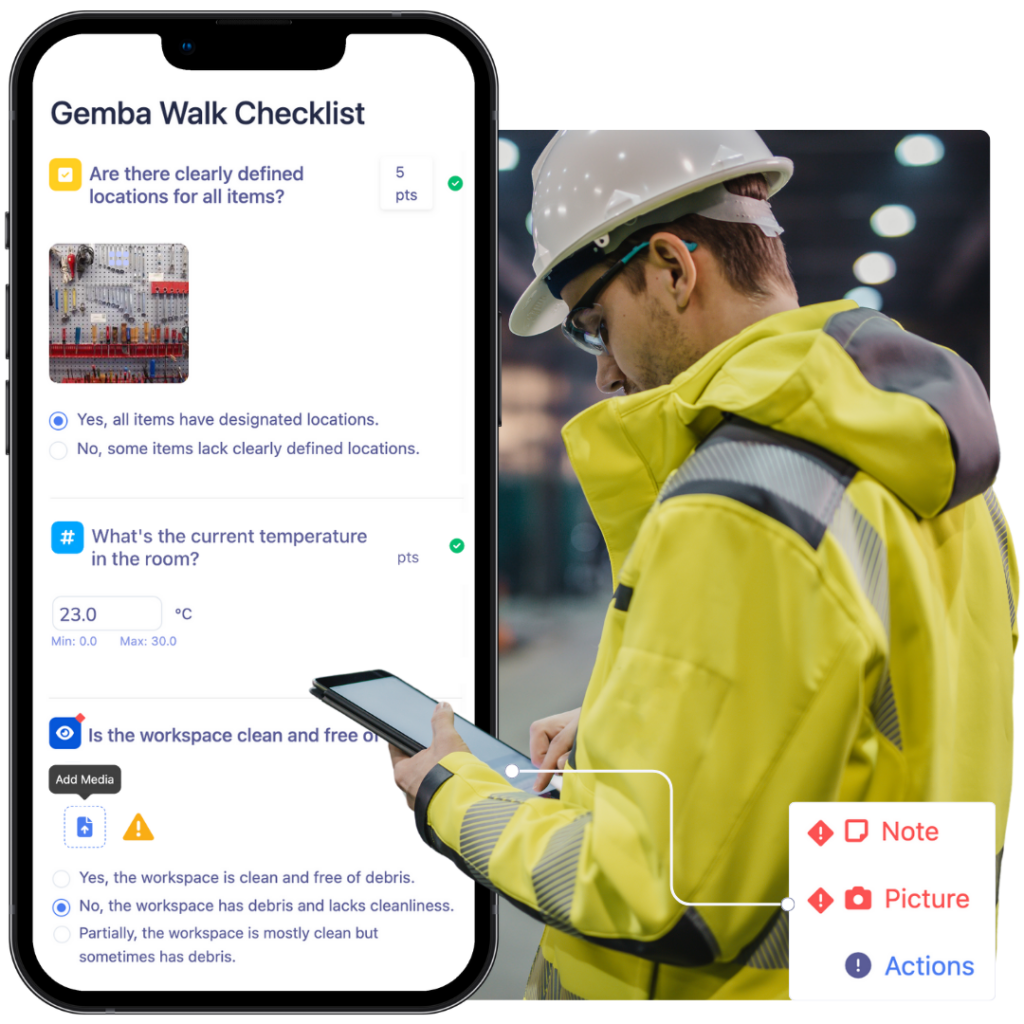
Digitize your Gemba Walks and supervisor checklists on mobile
- Create custom forms and checklists, and ensure frontline managers complete them on schedule.
- Turn Gemba walk observations into action, instantly
- Take notes and capture photos on mobile
Questions teams ask before the first walk
Plan 6 to 8 weeks from kick-off to walks running at their scheduled frequency in every area. The first two weeks cover buy-in, mapping, and checklist design. Weeks three and four are shadowing and the first supervised walks. The rest is adjusting the checklists against what the early walks actually find. Rolling out one area at a time takes longer and holds better than starting everywhere at once.
A fixed structure is what keeps the walks happening after the first month. When who walks, how often, and what they check are set in advance, every area gets covered at a predictable time, each issue reaches an owner, and a manager can see from the adherence data whether the routine is holding. Walks that depend on each manager’s spare time are the first thing dropped on a difficult shift.
Four things: a map of who walks which area and who owns each issue type, a checklist for each level and area, a published walk schedule, and one place to record each finding with its owner and due date. Paper and a shared spreadsheet are enough to start in one area. As the rollout reaches more areas and more walkers, keeping the checklists current and following up on every issue gets harder to do by hand, and that is usually when teams move the routine into software.
Check the schedule and the checklist before you check the supervisor. Walks get dropped most often because the checklist is too long to finish in the time allowed, because the walk is scheduled at a point in the shift when the floor is busiest, or because issues raised on earlier walks were never closed. Fix whichever of those applies, then review completion rates every week, walker by walker.
No. Each area needs its own questions, because the problems that recur on an assembly line are not the problems that recur in receiving or in packaging. What stays the same across areas is the structure: the same categories, the same number of questions, the same time limit. That keeps the walks comparable without making the questions generic.
Every issue gets a named owner and a due date at the post-walk debrief, and the owner is the person who can close it. Map the owner for each issue type before the first walk: safety, quality, maintenance and supply usually route to different people. An issue that leaves the debrief without an owner comes back on the next walk unchanged.


