















Build or Buy Software? Choosing the Right Path
| Audience: | Manufacturing and Healthcare Executives, Lean Management and Continuous Improvement Professionals, Operational Leaders and Safety Officers |
| Last updated: | May 19, 2026 |
| Read time: | 15 min |


- Building software internally requires significant time, resources, and ongoing maintenance
- Buying a solution enables faster deployment and earlier operational impact
- The key trade-off is between customization, internal capacity, and speed to execution
It happens every year in manufacturing.
A plant manager has been asking for a digital Daily Management System for months. Some teams reach for a custom build inside Microsoft Power Apps before evaluating a dedicated DMS. For a closer look at where that approach fits and where it falls short, see PowerApps for Manufacturing: Where Does It Fit? Leadership reviews the cost of a specialized solution, and a familiar idea comes up:
“We could build this ourselves.”
On paper, it makes sense. Full control. Tailored functionality. No vendor dependency.
But across the industry, this decision follows a pattern.
Projects take longer than expected. Adoption is slower than planned. And months later, operations are still running on whiteboards and spreadsheets, while internal teams continue to build.
The main problem is more about the hidden cost of time than about technical ability.
Build vs Buy Software Decision in Manufacturing: What It Really Means
The build vs buy software decision is often treated as a technical or IT-driven evaluation. In practice, it is a broader software project management decision with direct operational impact.
- Build: develop custom software internally, with full control over architecture, integrations, and roadmap
- Buy: adopt an existing software platform designed for a specific use case
The difference is ownership, as well as speed, scalability, and time to operational efficiency.
Industry leaders leverage Tervene to gain control over their daily operations


What Build or Buy Means in Software Project Management for Operations
In software project management, the build vs buy decision defines how a software solution is designed, delivered, and maintained over time.
A build approach requires managing the full lifecycle: designing the workflow, planning an integration phase with existing systems, allocating available resources, and ensuring ongoing software maintenance, updates, and scalability.
A buying software approach shifts that responsibility to a specialized provider. Internal teams focus on configuration, adoption, and aligning the platform with business needs, while benefiting from customer support, regular updates, and a defined product roadmap.
In manufacturing environments, this decision directly impacts:
- Speed of deployment and fastest implementation
- Internal capacity and resource allocation
Buy vs Build Analysis: Understanding the Operational Impact
Building a Digital DMS starts with a strong intent.
Requirements are defined. Workflows are mapped. Development begins, often with the goal of building an internal platform tailored to specific operational constraints and existing software.
This approach is valid and often well-structured.
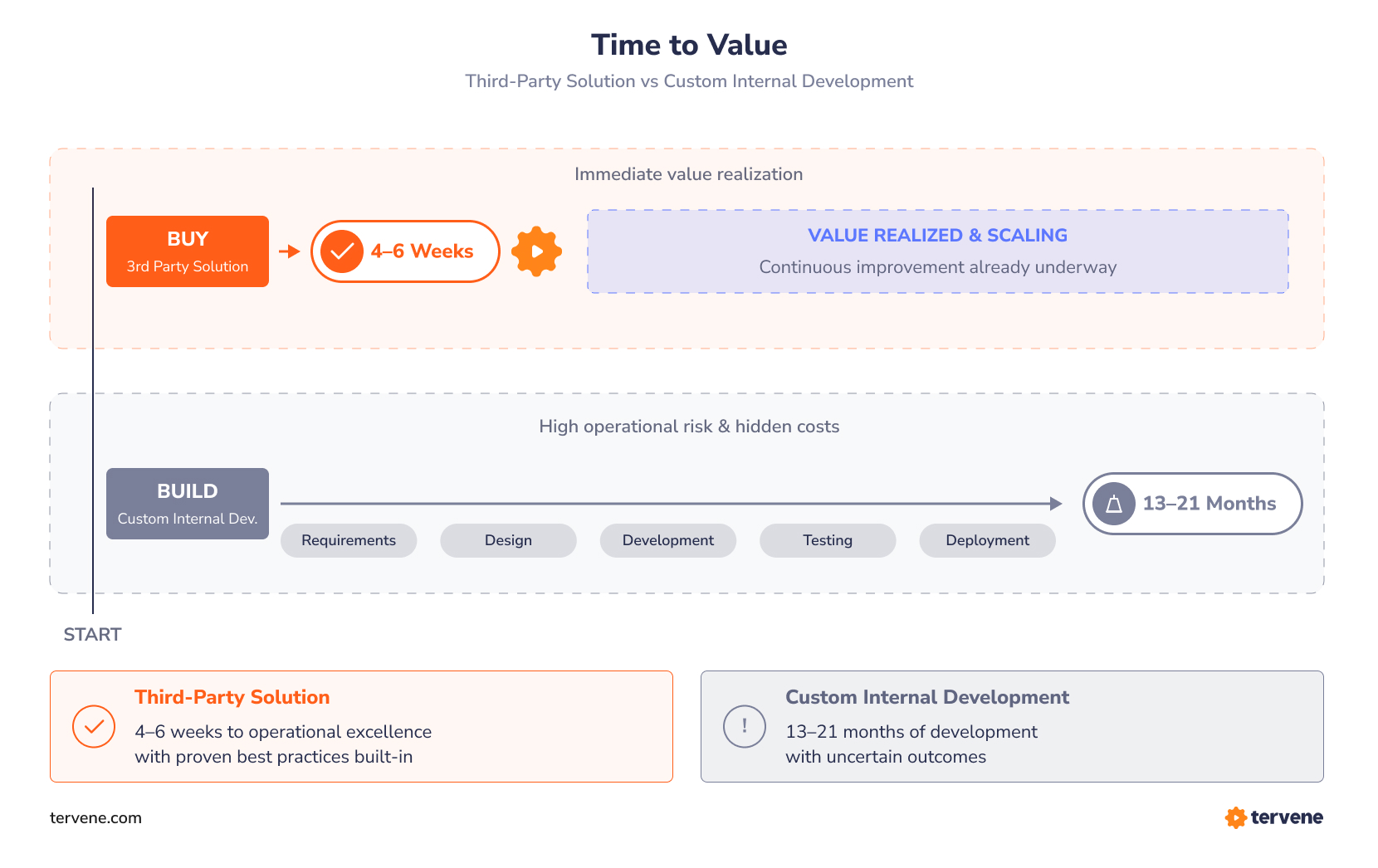
However, based on observed implementations, reaching a usable software solution typically takes 13 to 21 months.
During that time:
- Requirements evolve as teams assess feature fit and real-world usage
- Designing the workflow becomes more complex as edge cases appear
- IT teams balance competing priorities across multiple applications
Organizations must also:
- Plan an integration phase across systems
- Manage ongoing software maintenance and upgrades
- Align development with an internal roadmap
This creates a long-term ownership model with significant investment in development, maintenance, and scalability.
Most importantly, throughout this period, operations continue without a structured Daily Management System.
Buy vs Build Enterprise Software in Manufacturing Context
A specialized digital DMS platform is built to support real operational routines from day one.
Instead of building software internally, organizations adopt a platform developed using industry best practices and refined across multiple organizations.
These platforms typically include:
- Structured workflows aligned with operational standards
- Built-in analytics and business metrics visibility
- Integrated tools that support execution, not just reporting
These are not theoretical workflows. They are based on years of experience in manufacturing environments.
Deployment typically takes 4 to 6 weeks, including onboarding and training.
Internal teams focus on:
- Adoption and operational outcomes
- Aligning workflows with business needs
- Leveraging customer support and continuous improvements
Meanwhile, the platform handles:
- Ongoing software maintenance and regular updates
- Scalability across sites
- Continuous evolution through a structured product roadmap
Choosing the Right Software Approach for Daily Management Systems
Here’s how the two paths compare in real terms:
| Factor | Build (In-House) | Buy (SaaS) |
|---|---|---|
| Ownership | Full control over code and data flow | Platform-based, configurable control |
| Time to Deploy | 13–21 months to a working solution | 4–6 weeks to the operational system |
| Update Cadence | Manual, resource-dependent | Regular updates and improvements |
The choice is about which approach aligns with:
- Your operational urgency
- Your available resources
- Your tolerance for risk and complexity
The Scalability Failure Rate Beyond the Pilot Plant
A critical differentiator often missed in the initial “Build” phase is the transition from a single site to a global rollout. Internal development projects in manufacturing have a near-zero success rate when scaling across multiple sites.
While a custom tool might work for one “pilot” facility, it usually lacks the standardized architecture needed to handle diverse site configurations, languages, and regional reporting requirements. Buying a specialized platform ensures the infrastructure is multi-site ready from day one, whereas internal builds often require a complete “re-code” to move past the first plant.
Establish management standards with Tervene’s tools


Build vs Buy Software Development: What Internal Projects Involve
Internal software development projects are often well planned. The complexity emerges during execution.
Software Build vs Buy Considerations for Internal Teams
Capturing how work is done today is not the same as designing a system that ensures it is done consistently tomorrow.
A digital DMS is a system that:
- Enforces follow-through
- Structures workflows and daily routines
- Drives accountability across teams
This requires operational expertise, not only software development capability.
The “Product Owner” Drain on Leadership
There is a fundamental “Expertise Gap” in internal builds: IT teams know how to code, but they don’t know what to develop for a shop floor environment. This forces Operations Directors to step away from their core responsibilities to act as de facto Product Owners.
When you choose to build, your most senior leaders spend their time defining software specs and UI workflows instead of optimizing production. This “stolen time” is a hidden cost: you’re paying for developers and also sacrificing the strategic focus of your operational leadership.
Buy vs Build Custom Software: When Tailored Solutions Make Sense
Customization can be valuable in specific contexts.
Internal development may be appropriate when:
- Requirements are highly specific
- Systems must integrate deeply with existing software
- A strong internal product team is available
However, this must be balanced against long-term maintenance, scalability, and total cost of ownership.
Build vs Buy Software Assessment: Evaluating Internal Capabilities
Before committing to a build approach, organizations should assess:
- Available resources over the full lifecycle
- Ability to support ongoing maintenance and updates
- Experience with operational systems and workflows
- Impact of delayed implementation on business metrics
This assessment often shifts the discussion from feasibility to long-term sustainability.
Pros and Cons of Buy vs Build Software in Manufacturing Operations
Advantages of Building Custom Software Internally
- Full control over roadmap and system architecture
- Tailored functionality aligned with business needs
- Ownership of data and integrations
Limitations and Risks of Internal Development Projects
- Longer time to market
- Higher total cost of ownership
- Increased dependency on internal teams
- Adoption challenges if workflows are not enforced
- Near-zero success rate when scaling to other sites
- Displacement of Operations Directors into Product Owner roles
- Lack of internal resources to train and onboard new users
Benefits of Buying a Specialized Digital DMS Platform
- Faster implementation and quicker time to value
- Proven workflows and best practices
- Built-in customer support and regular updates
- Lower long-term operational risk
Discover why leaders choose Tervene as their Daily Management System
Download your executive summary
Build vs Buy Software Cost: The Full Financial Picture
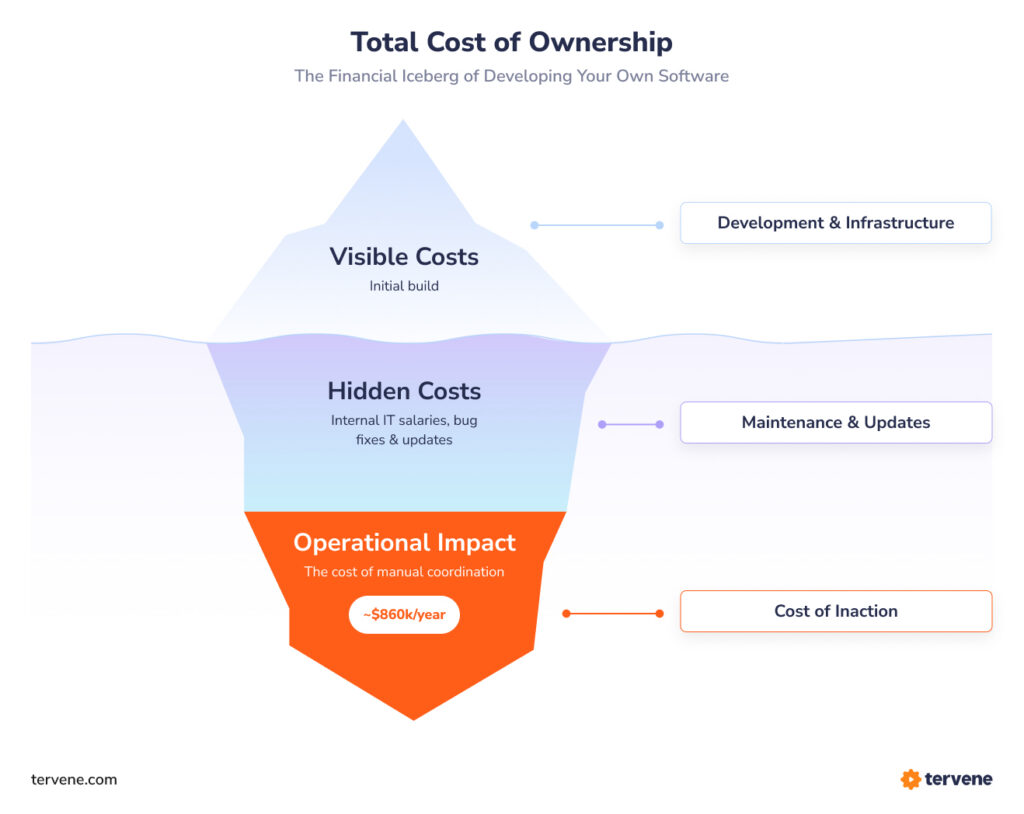
Direct Costs of Internal Development vs SaaS
A typical digital DMS project represents:
- $580,000 to $950,000 over 2 years
- $80,000 to $150,000 annually in maintenance
A SaaS platform typically represents:
- ~$30,000 to $40,000 per year
Hidden Operational Costs During Development
While a system is being built, operations continue without structured daily management.
This leads to:
- Manual coordination and reporting
- Delayed issue detection
- Preventable downtime
- Rework and quality losses
A conservative estimate places this at ~$860,000 per plant per year. Learn more about this in our article about the cost of inaction.
This is the cost most organizations do not include in their initial analysis.
Total Cost of Ownership: Build vs Buy Software
The financial comparison extends beyond initial pricing.
It includes:
- Development or subscription costs
- Ongoing software maintenance
- Internal resource allocation
- Operational efficiency during implementation
Organizations that evaluate total cost of ownership tend to prioritize speed, scalability, and long-term performance over short-term control.
Software Build vs Buy Matrix: Comparing Build and SaaS in Practice
| Factor | Build (In-House) | Buy (Specialized Platform) |
|---|---|---|
| Time to deploy | 13–21 months | 4–6 weeks |
| Initial cost | $580K–$950K | ~$30K–$40K/year |
| Maintenance | Internal | Included |
| Operational impact | Delayed | Immediate |
| Adoption risk | Higher | Lower with proven workflows |
| Multi-site scalability | Near-zero success rate beyond site #1 | Engineered for global standardization |
| Leadership impact | Monopolizes Operations Directors’ time | High autonomy; managed by vendor |
Software Buy vs Build Decision Framework for Manufacturing Leaders
Key Factors: Time, Resources, and Operational Urgency
The decision should consider:
- Available resources and internal capacity
- Business needs and level of customization
- Time to deployment and speed requirements
- Scalability and long-term maintenance
Organizations should also evaluate whether the system is a core competitive advantage or a supporting operational tool.
Build vs Buy Software Examples from Manufacturing Environments
Across manufacturing organizations, a consistent pattern emerges:
- Internal builds extend timelines and increase complexity
- Adoption improves when systems are designed with operational workflows in mind
- Faster deployment leads to earlier gains in operational efficiency
Build vs Buy vs Partner: Exploring Alternative Approaches
Some organizations consider hybrid approaches:
- Internal development supported by external partners
- Extending existing platforms through integrations or plugins
These approaches can work, but still require careful management of ownership, maintenance, and scalability.
Build vs Buy AI Software: Does AI Change the Decision?
Where AI Accelerates Development
AI tools can accelerate:
- Prototyping
- Interface generation
- Development workflows
Why Operational Systems Still Require Domain Expertise
However, AI does not replace:
- Workflow design
- Operational best practices
- Behaviour enforcement
Yes, a Digital DMS is a software, but beyond that, it is an operational system built on experience.
When to Build vs Buy Software: A Practical Decision Guide
When Internal Development Is Justified
- Highly unique requirements
- Dedicated long-term development capacity
- Strong internal ownership model
When Buying Delivers Faster Value
- Need for rapid deployment
- Adoption is critical
- Limited internal resources
- Alignment with proven operational practices
In most manufacturing environments, the priority is speed, scalability, and consistent execution.
Build vs Buy Software Is an Execution Decision
The build vs buy decision is about how organizations allocate resources, manage complexity, and improve operational efficiency.
Building software internally offers full control and tailored functionality, but requires significant time, investment, and ongoing maintenance.
Buying software provides faster deployment, regular updates, and a clearer path to results.
The most important question is not: “Can we build this?”
It is: “How long can we afford to wait?”
Ready to See What a Digital DMS Looks Like in Practice?
If you are evaluating build vs. buy, the most effective next step is to see how a proven system works in a real operational context.
Tervene is designed specifically for manufacturing leaders who want to:
- Structure daily management routines
- Increase accountability across teams
- Detect and resolve issues faster
- Standardize execution across sites
Deployment takes weeks, not months. Your teams are supported with training, guidance, and ongoing assistance. And the system is built on years of real-world operational experience.
Digitalize your Daily Management System (DMS)
- Standardize management practices
- Gain control over your daily operations
- Establish management standards across the organization
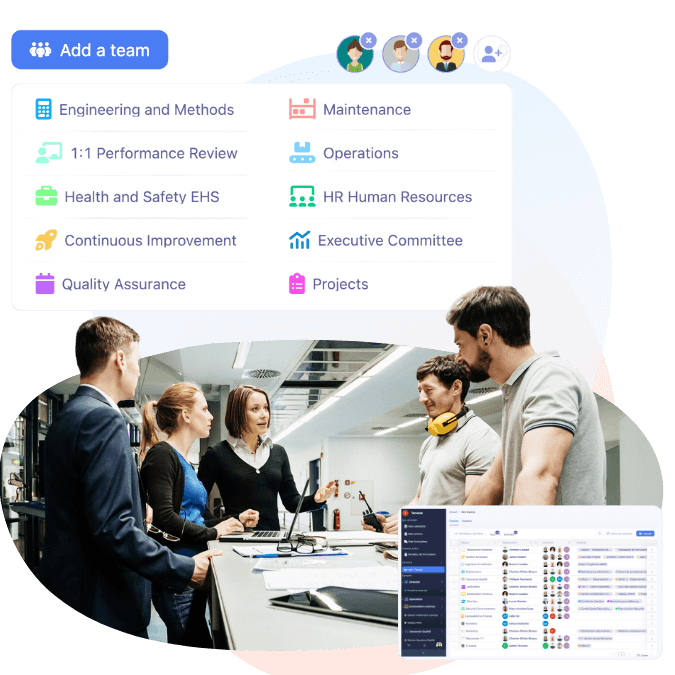
Book a demo to see how a digital DMS can be deployed in your environment and start delivering results quickly.
FAQ: Build vs Buy Software
Build means developing a custom system internally. Buy means deploying a ready-to-use SaaS platform.
The key difference is not only ownership. It is:
- Time to deployment
- Adoption reliability
- Ongoing maintenance effort
Build focuses on customization. Buy focuses on speed and proven execution.
It depends on your capacity and priorities.
Building can make sense if you have:
- Dedicated development resources
- Highly specific requirements
- Long-term maintenance capability
Buying is often more effective when:
- You need results quickly
- Adoption is critical
- Internal resources are limited
Most manufacturing organizations prioritize speed-to-value and consistency.
A realistic timeline is 13 to 21 months to reach a working solution.
This includes design, development, testing, and iteration.
Additional time is often required to improve adoption after launch.
Most platforms can be deployed in 4 to 6 weeks, including configuration and training.
This allows teams to begin using the system and improving operations almost immediately.
A typical internal build costs $580,000 to $950,000 over the first two years.
Ongoing maintenance adds $80,000 to $150,000 annually.
These costs include development, infrastructure, and continuous support.
A SaaS Digital DMS typically costs $30,000 to $40,000 per year for a mid-size plant.
This includes:
- Platform access
- Updates and improvements
- Support and onboarding
The investment is predictable and significantly lower than internal development.
The highest cost is operating without a structured system during development.
Without a Digital DMS:
- Issues are detected later
- Downtime increases
- Manual work persists
This represents approximately $860,000 per year per plant.
Most internal tools focus on:
- Data capture (forms, dashboards)
But they often lack:
- Workflow enforcement
- Automatic escalation
- Structured daily routines
A Digital DMS must support behaviour, not just visibility. This is what drives adoption.
Build if:
- Your needs are highly unique
- You have long-term development capacity
- You can support ongoing maintenance
Buy if:
- You need a system quickly
- Adoption is critical
- You want proven workflows and support
In most cases, the deciding factor is time to adoption, not customization.